Welcome: SANYO DENKI San Ace cooling fan product chain in China region
Language:
 ∷
∷

∷
 ∷
∷

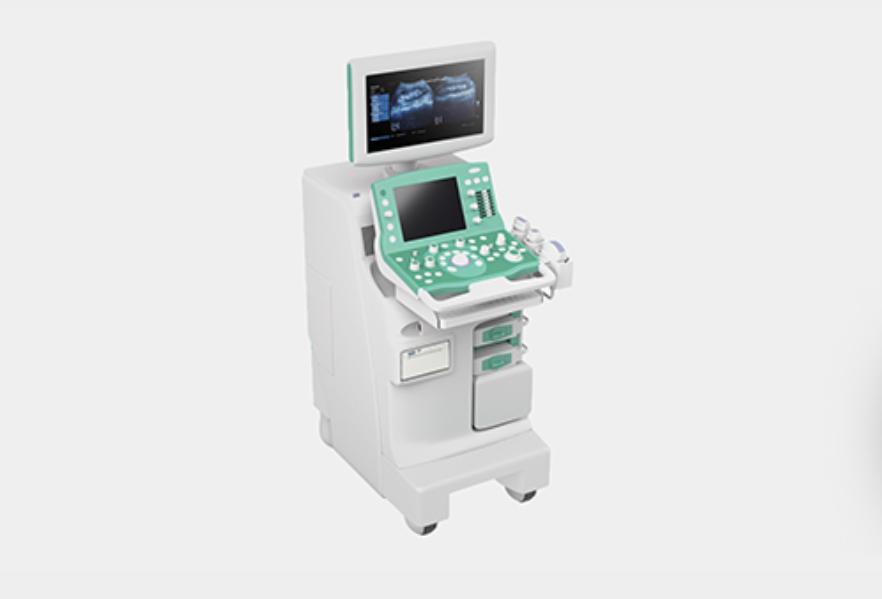
In an ultrasound examination room, high-frequency sound waves are used to generate diagnostic images in real time.
The diagnostic process may appear quiet and calm, but inside the ultrasound system, multiple electronic components are working continuously—and generating heat.
This makes cooling an essential part of ultrasound equipment design.
However, there is a unique challenge:
The cooling fan must remove heat effectively without becoming a source of unnecessary noise.
For ultrasound diagnostic equipment used in quiet examination rooms, fan selection is therefore not simply about choosing the highest airflow.
It is about finding the right balance between:
Cooling performance + noise reduction + vibration control + reliability + power consumption
This is where San Ace DC Cooling Fans can provide an effective approach for medical equipment cooling. SANYO DENKI describes its San Ace DC fans as offering high airflow, high reliability, and low noise, with product lines covering a wide range of sizes and performance requirements.
Ultrasound diagnostic equipment integrates multiple electronic systems, including:
| Internal Module | Typical Function | Cooling Consideration |
|---|---|---|
| Signal Processing | Processes ultrasound signals | Continuous heat generation |
| Main Control Board | Controls equipment operation | Stable temperature required |
| Power Supply | Converts and distributes power | Significant heat source |
| Display System | Displays real-time images | Continuous operation |
| Communication Interfaces | Data transmission and communication | Heat management required |
| Probe-Related Electronics | Processes high-frequency signals | Thermal stability |
During prolonged operation, heat generated by these components accumulates inside the enclosure.
If the internal temperature rises excessively, it can affect the operating environment of electronic components.
Therefore, an effective thermal design should consider:
Heat generation → Airflow → Heat removal → Temperature control → Long-term reliability
The cooling fan is an important part of this chain.
A fan operating inside an industrial cabinet may be surrounded by other mechanical or environmental noise.
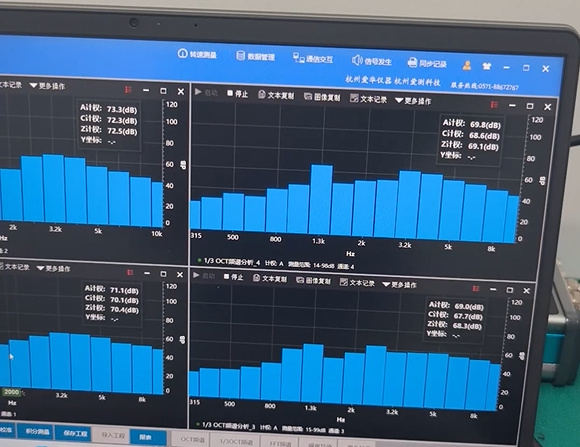
An ultrasound examination room is different.
The environment is often relatively quiet, and communication between the physician and patient is part of the examination process.
A continuous fan sound can therefore become more noticeable.
This is especially relevant when:
Physicians need to communicate with patients
Doctors need to concentrate during examinations
Equipment operates in quiet examination rooms
Children or elderly patients may be more sensitive to environmental noise
Medical staff need to maintain concentration during long examinations
This creates a fundamental cooling challenge:
How can the equipment maintain sufficient cooling without simply increasing fan speed?
The answer begins with proper fan selection.
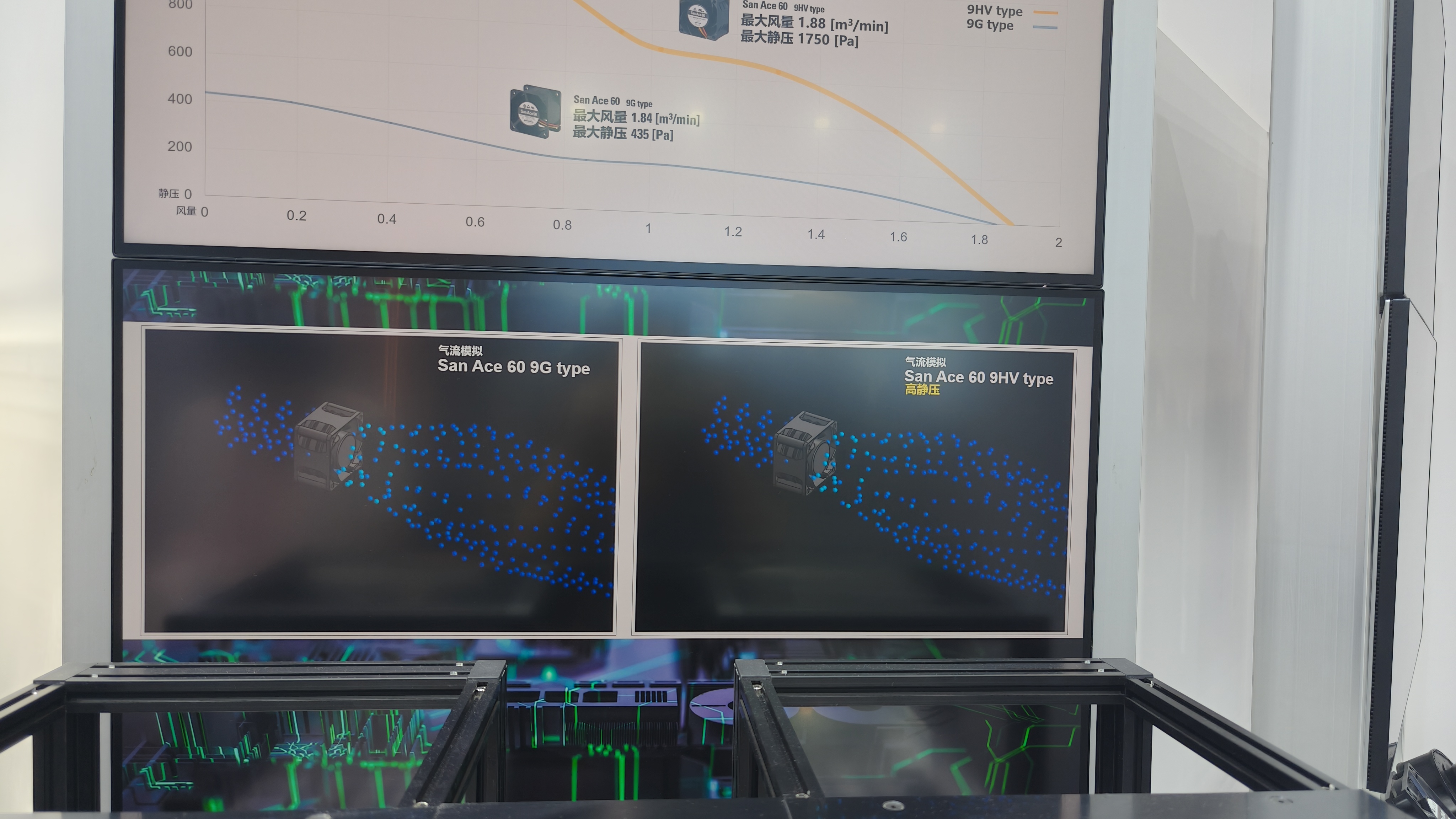
When selecting a cooling fan for ultrasound equipment, maximum airflow is only one parameter.
The fan must also overcome the resistance created by the equipment's internal airflow path.
Typical sources of airflow resistance include:
Dust filters
Protective grilles
Narrow air passages
PCB assemblies
Heat sinks
Internal structures
Air inlet and outlet openings
Therefore:
A fan's maximum airflow is generally measured under free-air conditions.
Once installed inside an ultrasound system, the actual operating point changes according to system resistance.
A practical way to understand this is:
Fan performance curve × System resistance curve = Actual operating point
This is why medical equipment cooling should consider:
Airflow + Static Pressure + Noise + Power Consumption + Temperature + Expected Life
rather than comparing only the CFM value.
A common assumption is:
“If we want a quieter fan, we have to reduce the speed, and reducing the speed means reducing airflow.”
There is certainly a relationship between fan speed and cooling performance.
However, fan design does not have to be a simple choice between “high airflow” and “low noise.”
San Ace DC fans are developed by reviewing factors such as impeller shape, motor characteristics, operating airflow, and expected life to achieve targeted performance. The product range is designed around high airflow, high static pressure, low power consumption, and low vibration.
The objective is therefore not simply:
❌ A fan that spins as fast as possible
but rather:
✅ A fan that provides sufficient cooling at the actual system operating point while minimizing unnecessary noise, vibration, and power consumption.
When evaluating fan noise, it is easy to focus entirely on the SPL specification.
But the acoustic performance of a medical device depends on more than the fan itself.
This can include aerodynamic noise from the rotating impeller and motor-related operating noise.
The shape of the air inlet, outlet, grille, filter, and internal structures can influence airflow turbulence and resulting noise.
Mechanical vibration from the fan can be transmitted through the equipment enclosure and become structural noise.
If the fan continuously runs at maximum speed, the resulting sound can become more noticeable.
Therefore:
Quiet cooling should be considered as a system-level design issue—not simply a fan specification.
Imagine an ultrasound system operating at a relatively low thermal load.
If the fan continues running at maximum speed, the equipment may generate more fan noise and consume more power than necessary.
This is where PWM speed control can become valuable.
San Ace offers models with PWM control, allowing fan speed to be controlled according to equipment requirements. SANYO DENKI specifically notes that PWM control can help optimize noise levels and efficiency.
A typical control concept is:
↓
Reduce fan speed
↓
Reduce unnecessary noise and power consumption
↑
Increase fan speed
↑
Increase cooling capacity
This creates a more intelligent relationship:
Equipment temperature → Fan speed → Cooling capacity
Instead of:
Equipment ON → Fan always at maximum speed
For medical equipment, a cooling fan should not necessarily be treated as a “fit-and-forget” component.
San Ace DC fans can be equipped with different sensor and control options, including pulse sensors, locked-rotor sensors, low-speed sensors, and PWM control depending on the model.
| Function | Purpose | Potential Value in Medical Equipment |
|---|---|---|
| Pulse Sensor | Detects fan speed | Monitoring operating status |
| Locked-Rotor Sensor | Detects fan rotation stop | Helps identify fan failure |
| Low-Speed Sensor | Detects abnormally low speed | Helps identify reduced cooling |
| PWM Control | Controls fan speed | Matches cooling to thermal load |
This makes the cooling system more controllable and easier to monitor.
Ultrasound diagnostic equipment may operate for extended periods.
The cooling fan may experience:
Long operating hours → Continuous rotation → Temperature changes → Repeated operation → Long-term mechanical stress
Therefore, fan selection should consider more than initial airflow performance.
Important factors include:
✔ Expected life
✔ Operating temperature
✔ Bearing configuration
✔ Vibration
✔ Speed stability
✔ Long-term operating reliability
✔ Fan-status monitoring
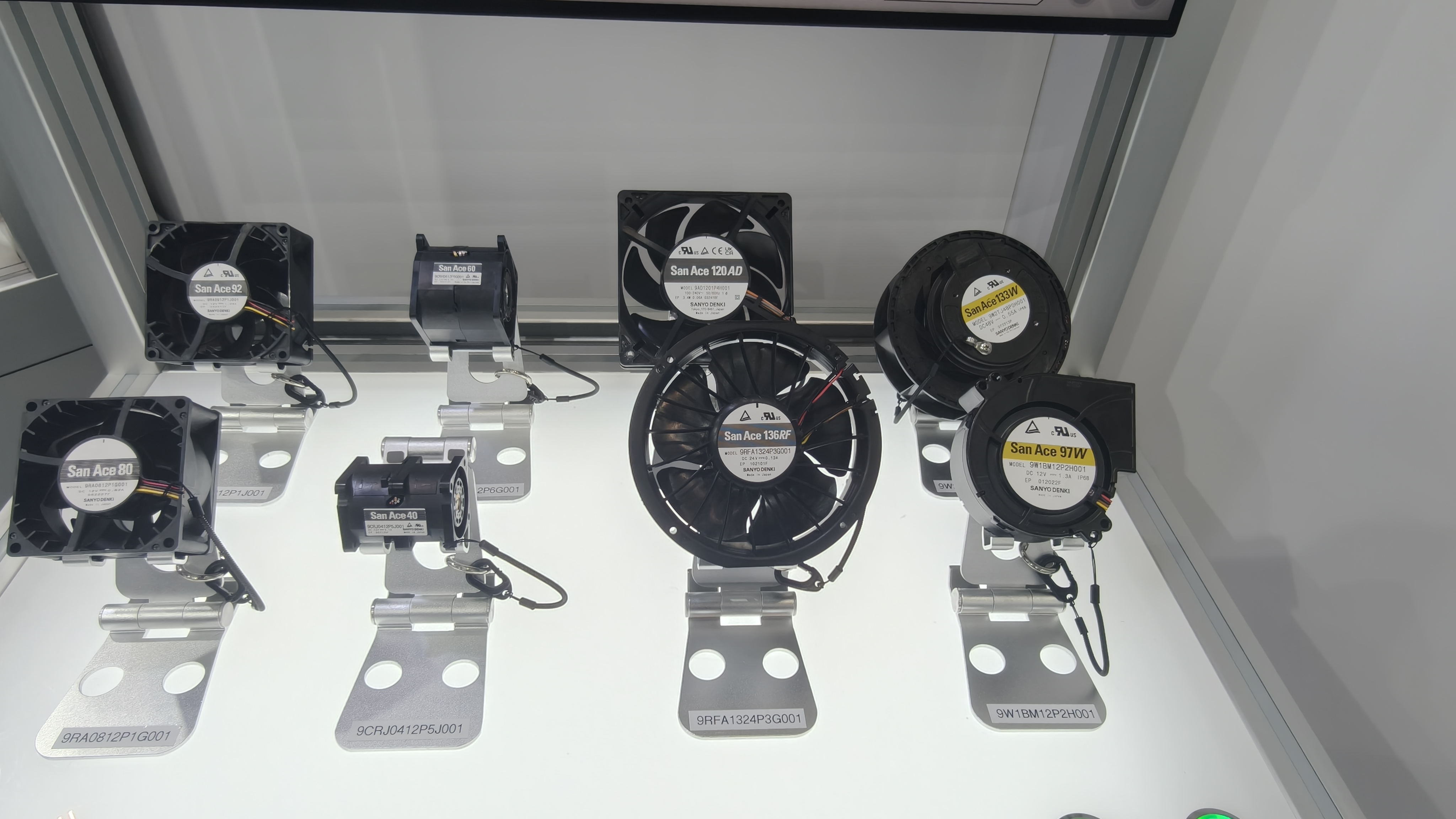
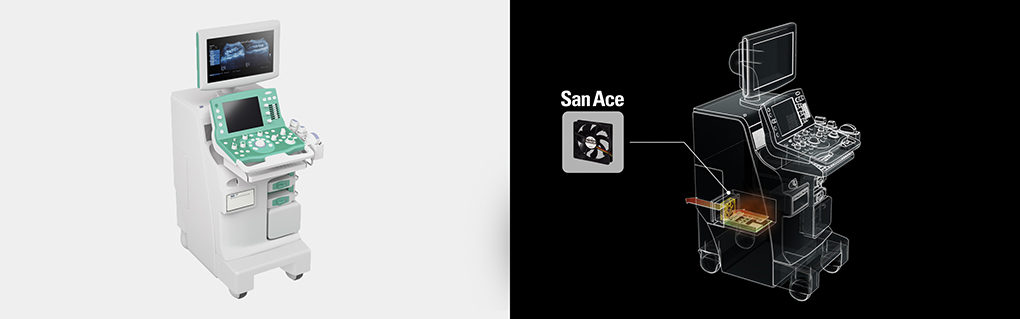
For example, SANYO DENKI's San Ace 9RA 92 × 92 × 25 mm DC fan was specifically developed for applications requiring particularly quiet operation, including medical equipment. The product information lists 60,000 hours of expected life under specified conditions.
The San Ace 80 9RA series is also positioned for medical equipment and applications requiring both cooling performance and noise reduction.
Medical equipment does not have one universal thermal design.
Different systems may have different:
Available installation space
Thermal loads
Airflow resistance
Noise requirements
Power budgets
Operating environments
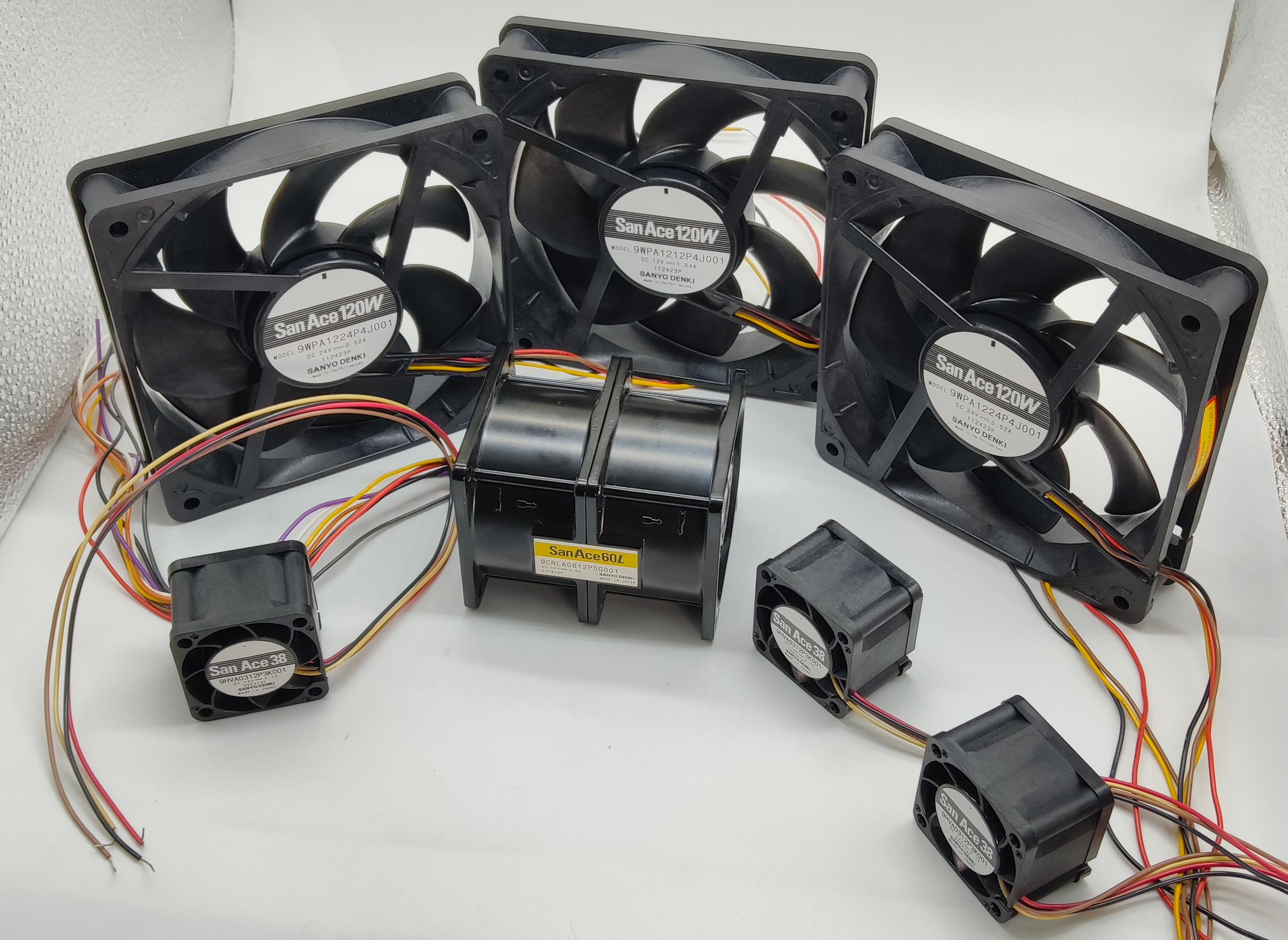
San Ace DC Cooling Fans therefore include a broad range of product categories, including:
DC Fan
Low Power Consumption Fan
Silent Fan
Splash Proof Fan
Oil Proof Fan
Long Life Fan
Counter Rotating Fan
Blower
SANYO DENKI states that its DC cooling fan lineup covers more than 80 frame sizes, providing different combinations of airflow and static pressure.
This allows designers to select a cooling solution according to actual equipment requirements rather than forcing one fan design into every application.
For an ultrasound diagnostic system, the following six parameters are particularly important:
| Selection Parameter | Key Question |
|---|---|
| Airflow | How much actual airflow does the system require? |
| Static Pressure | Can the fan maintain airflow against system resistance? |
| Noise | What noise level is acceptable in the examination environment? |
| Power | Can the fan operate efficiently during long periods? |
| Control | Is PWM speed control required? |
| Monitoring | Is fan-speed or fault detection required? |
Don't start with:
“Which fan has the highest airflow?”
Start with:
“What cooling capacity does the ultrasound system actually need?”
Then match the fan to the system's thermal load, airflow resistance, installation space, acoustic requirements, and reliability targets.
For ultrasound equipment, an effective thermal solution should be considered as a complete system.
A typical design process can be:
Thermal analysis
↓
Determine required heat dissipation
↓
Analyze internal airflow path
↓
Evaluate system resistance
↓
Select airflow/static pressure
↓
Evaluate noise and vibration
↓
Select fan size and control method
↓
Verify long-term reliability
This approach helps prevent a common mistake:
Selecting a fan based only on catalog airflow while ignoring the actual operating environment.
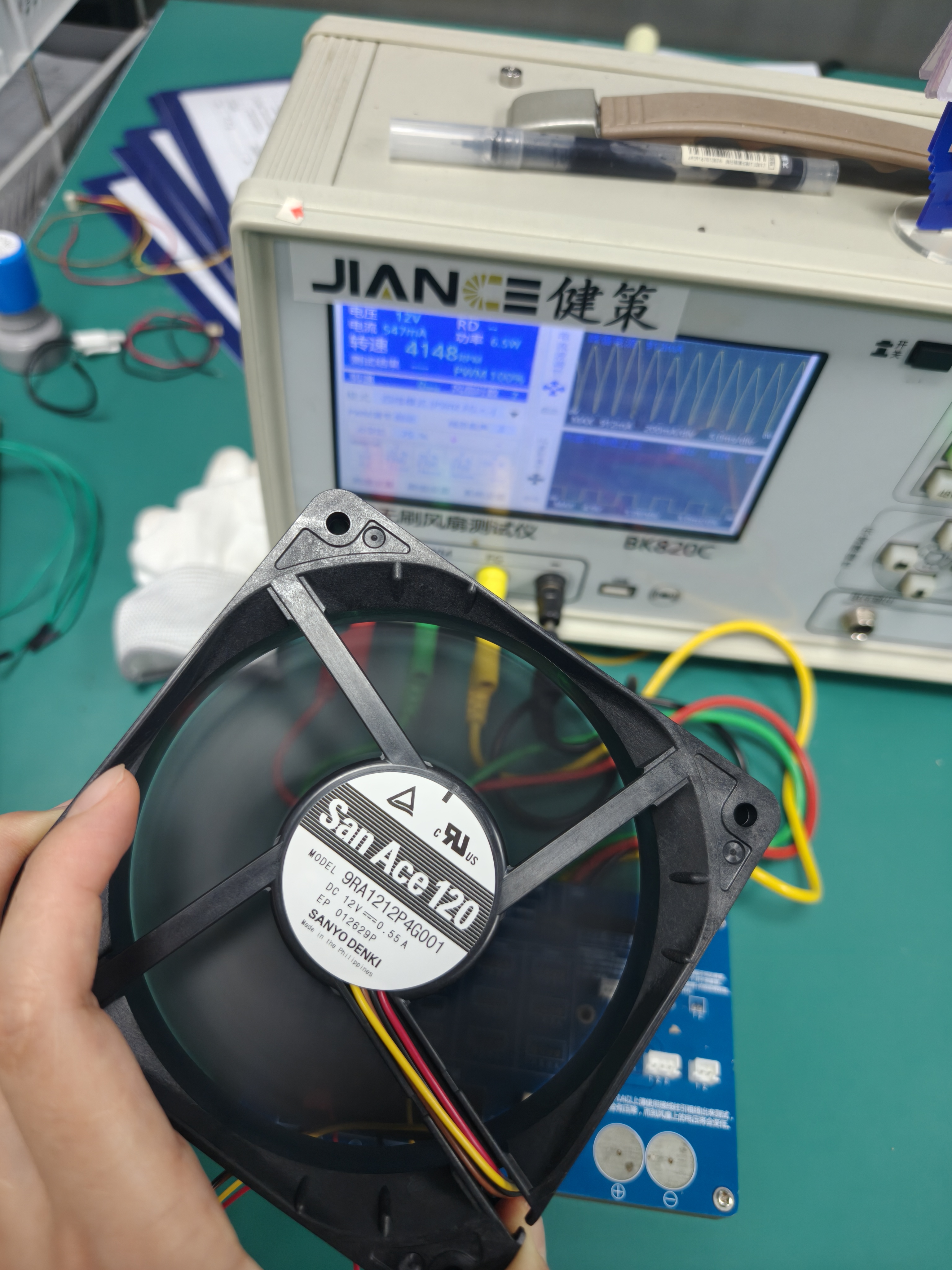
For applications where acoustic performance is especially important, the San Ace 9RA low-noise series is worth considering.
For example, SANYO DENKI's 92 × 92 × 25 mm 9RA type was developed specifically for applications requiring particularly quiet operation, including medical equipment and measuring instruments. Compared with the previous model, SANYO DENKI reported more than a 50% reduction in noise and a 44% reduction in power consumption under the stated comparison conditions. Models with PWM control can further optimize fan speed, noise, and efficiency.
The 80 × 80 × 25 mm 9RA type is likewise positioned for medical and AV equipment. Its published lineup includes different speed, airflow, pressure, and noise configurations, allowing designers to select according to application requirements.
The 60 × 60 × 25 mm 9RA type is another compact option for medical equipment requiring quiet operation. SANYO DENKI reports a broad 12/24/48 V lineup, different cooling-performance levels, and PWM options.
The quieter the application environment, the more important it becomes to select the fan based on the complete operating point—not simply the frame size.
The primary mission of an ultrasound diagnostic system is to provide doctors with clear, real-time diagnostic information.
The mission of the cooling fan is to continuously remove heat and maintain an appropriate operating environment for the electronics.
These functions may seem unrelated, but they share an important connection:
A stable, low-interference cooling system helps the medical equipment operate reliably while minimizing unnecessary acoustic disturbance.
Therefore, an excellent medical equipment cooling solution should not simply pursue:
Higher airflow + Higher speed
Instead, it should pursue:
Appropriate airflow + Sufficient static pressure + Low noise + Low vibration + Reliable operation + Intelligent control
In an ultrasound examination room, the ideal cooling fan is not necessarily one that is completely inaudible.
It is one that:
Provides sufficient cooling when the equipment needs it;
avoids unnecessary high-speed operation when the thermal load is low;
maintains reliable performance during long operating periods;
and minimizes unnecessary acoustic interference during diagnosis.
That is the value of quiet cooling design.
San Ace DC Cooling Fans combine a broad product lineup with technologies focused on high airflow, high static pressure, low power consumption, low vibration, low noise, sensor functions, and PWM control, providing flexible options for medical electronic equipment.
Medical equipment cooling is not simply about moving heat away.
It is about creating a cooling system that works quietly in the background:
Stable equipment operation.
Reduced acoustic interference.
Reliable long-term cooling.
A more comfortable diagnostic environment.
✔ High Airflow
✔ High Static Pressure
✔ Low Power Consumption
✔ Low Vibration
✔ Low Noise Options
✔ PWM Speed Control
✔ Pulse / Locked-Rotor / Low-Speed Sensor Options
✔ Wide Range of Frame Sizes
✔ Multiple Product Lines for Different Applications
From a cooling fan to a complete thermal-management concept, San Ace continues to develop cooling technologies designed to support reliable operation of medical and other precision electronic equipment.
jamicon cooling fan,AVC cooling fan,jentech cooling fan,AVC fan
Contact: Mr. Wang
Phone: 18148574796
Tel: 0755-23706799
Email: wmc@jentech.cn
Add: No. 28, Tongyuwu Industrial Zone, Kuikeng Community, Guanlan Street, Longhua District, Shenzhen City. 6th floor, Building 1, Hualangjia Industrial Park
 Click to inquire