Welcome: SANYO DENKI San Ace cooling fan product chain in China region
Language:
 ∷

∷
 ∷

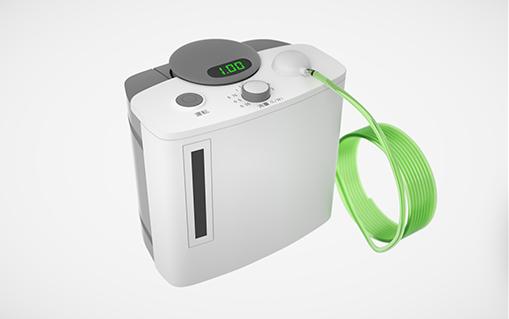
An oxygen concentrator draws in ambient air and supplies oxygen-enriched gas.
Although the basic principle sounds simple, the compressor inside the device must operate continuously to support the air compression process. Continuous operation also means continuous heat generation from the motor, mechanical components, and compression process.
As compressor operation continues, heat continues to accumulate.
If this heat cannot be effectively removed, the temperature around the compressor and other internal components may rise, potentially affecting the long-term stability of the equipment.
This makes the cooling fan more than just a component that “moves air.” It is an important part of the thermal management system for the compressor.
So, what kind of cooling fan does an oxygen concentrator compressor actually need?
That is where SANYO DENKI San Ace DC fans come into focus.
Space inside an oxygen concentrator is often limited, so the available fan size can be restricted by the equipment structure.
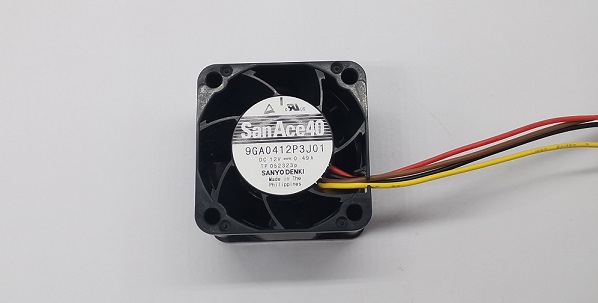
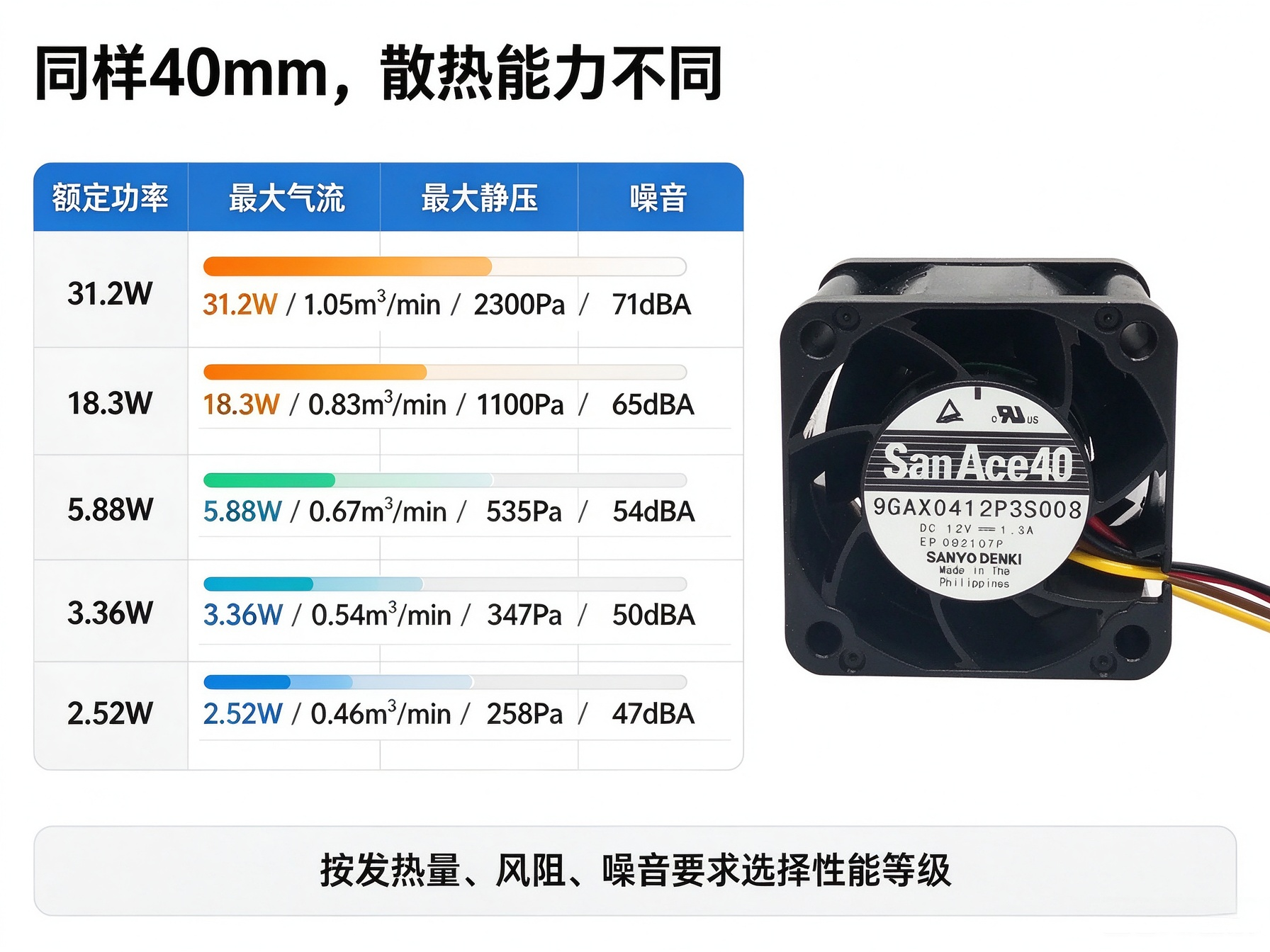
Taking the 40 × 40 × 28 mm frame size as an example, SANYO DENKI San Ace offers models with different combinations of airflow, static pressure, power consumption, and noise.
The following models are listed only as representative examples to illustrate one key point:
The same installation size does not necessarily mean the same cooling capability.
| Model | Rated Voltage | Rated Power | Maximum Airflow | Maximum Static Pressure | Noise |
|---|---|---|---|---|---|
| 9HVA0412P3J001 | 12 V | 31.2 W | 1.05 m³/min | 2300 Pa | 71 dBA |
| 9HV0412P3K001 | 12 V | 18.3 W | 0.83 m³/min | 1100 Pa | 65 dBA |
| 9GA0412P3J01 | 12 V | 5.88 W | 0.67 m³/min | 535 Pa | 54 dBA |
| 9GA0412P3H01 | 12 V | 3.36 W | 0.54 m³/min | 347 Pa | 50 dBA |
| 9GA0412P3M01 | 12 V | 2.52 W | 0.46 m³/min | 258 Pa | 47 dBA |
These figures show that different performance combinations are available even within the same 40 × 40 × 28 mm frame size.
Therefore, selecting a cooling fan for an oxygen concentrator compressor is not simply a matter of checking whether the fan fits the mounting space. Engineers also need to consider compressor heat generation, internal airflow paths, system resistance, and noise requirements.
This brings us back to the key technical question:
Why does compressor cooling place such specific demands on the cooling fan?
The compressor is one of the key components involved in the air compression process inside an oxygen concentrator.
During continuous operation, the compressor generates heat through motor operation, mechanical movement, and air compression.
If this heat continues to accumulate, the temperature inside the equipment can rise.
The role of the cooling system is therefore to:
Remove heat generated by the compressor and help maintain a stable operating temperature.
The thermal management process can be simplified as:
Compressor generates heat → Cooling fan creates airflow → Air passes through the heated area → Hot air is discharged → Fresh air enters → Continuous cooling circulation
If any part of this process becomes restricted, the overall cooling performance can be affected.
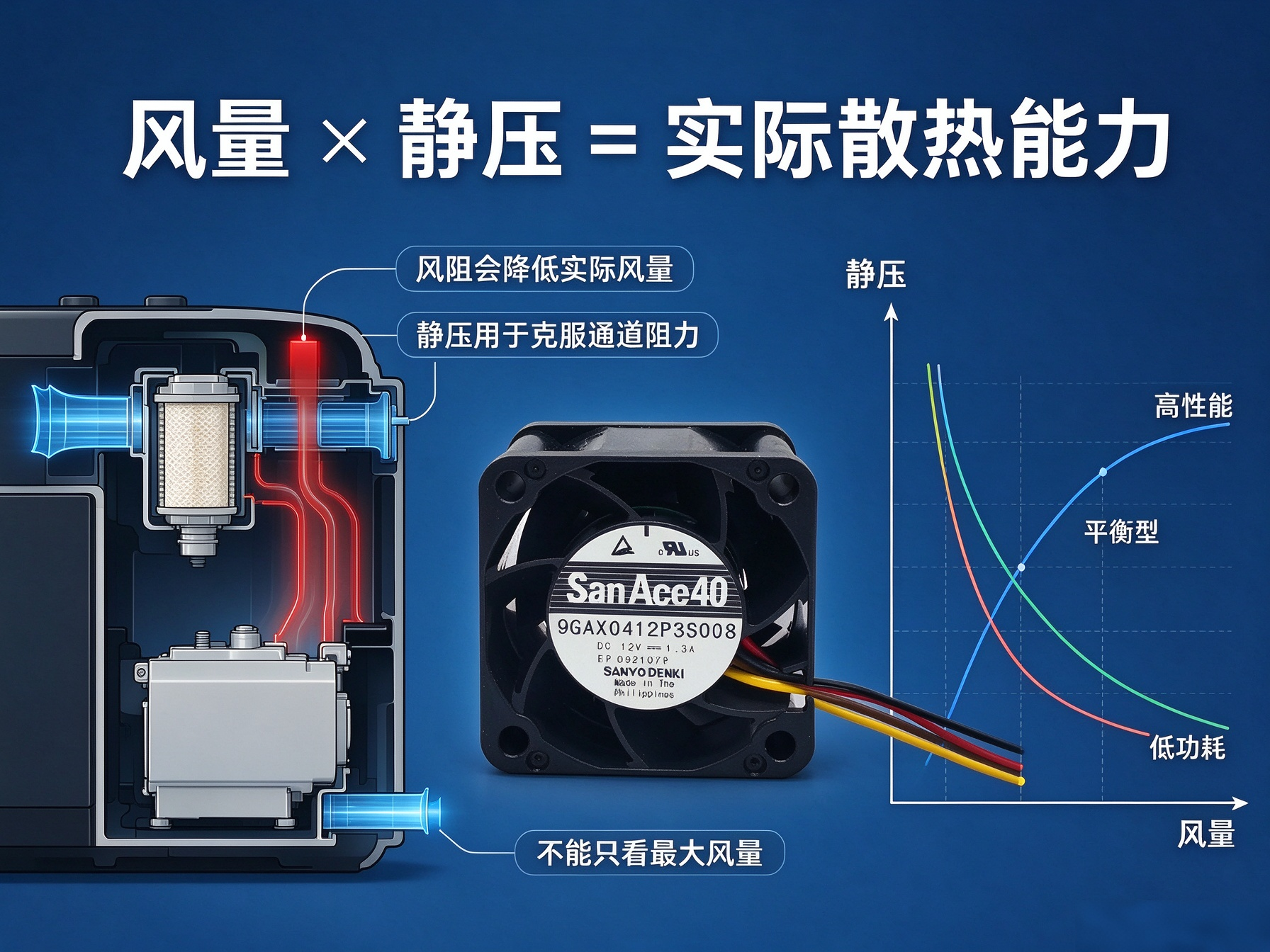
This is why cooling fan selection should not be based on only one parameter such as maximum airflow.
This is one of the most important points in cooling fan selection.
When selecting a fan, it is common to start with a simple question:
“How much air can this fan move?”
However, once the fan is installed inside equipment, the air is no longer flowing in an unrestricted environment.
The system may include:
Restricted air inlets
Restricted air outlets
Protective structures
Filters
Internal airflow channels
Compressor components
Structural obstructions
Bends or narrow sections in the airflow path
All of these can create system resistance.
As a result, the actual operating point of the fan depends on both airflow and static pressure.
Higher airflow generally means that more air can participate in heat exchange within a given period, assuming other conditions are comparable.
When the equipment has significant airflow resistance, a fan with insufficient static pressure capability may deliver considerably less airflow after installation, even if its specified maximum airflow is high.
Therefore:
For compressor cooling in an oxygen concentrator, the goal is not simply to maximize airflow. The key is to match the fan performance with the resistance of the actual system.
This is an important consideration when selecting a San Ace DC fan.
SANYO DENKI San Ace DC fans are available in different performance categories to address different equipment cooling requirements.
For example:
| Cooling Requirement | Key Parameters | Suitable Product Direction |
|---|---|---|
| Higher compressor heat generation | Airflow, static pressure | High-performance DC fan |
| Power consumption is critical | Power, airflow | Low-power fan |
| Equipment is sensitive to noise | Noise, airflow | Low-noise solution |
| Long-term continuous operation | Expected life | Long-life solution |
| Fan operation needs to be monitored | Speed signal | Pulse sensor |
| Fan speed needs to be adjusted | Speed control | PWM control |
In other words, there is no need to use a single fan configuration for every oxygen concentrator.
The fan can instead be selected according to the actual thermal and operating requirements of the equipment.
Noise is another important consideration for oxygen concentrators.
Unlike many industrial systems, oxygen concentrators may be used in environments where operating sound is particularly noticeable.
Increasing fan speed can provide higher airflow, but it may also increase noise and power consumption.
This creates an engineering balance:
Cooling performance ↑ → Fan speed may ↑ → Noise may ↑ → Power consumption may ↑
Therefore, after the required cooling performance has been achieved, engineers also need to consider the noise level.
For example, among 40 × 40 × 28 mm models:
9GA0412P3J01: 54 dBA
9GA0412P3H01: 50 dBA
9GA0412P3M01: 47 dBA
At the same time, their maximum airflow and static pressure also differ.
Therefore, the correct approach is not simply:
“The lower the noise, the better.”
Instead, the engineering process should be:
Meet the required cooling performance first, then evaluate the noise and power consumption among suitable models.
Oxygen concentrators may need to operate for extended periods, which makes cooling fan reliability particularly important.
Fan performance should therefore not be evaluated only at the beginning of operation.
Engineers also need to consider whether the fan can continue providing stable cooling performance over long-term operation.
For example, some San Ace 40 × 40 × 28 mm DC fan models have an expected life of:
40,000 hours at 60°C / 70,000 hours at 40°C
Other models provide:
60,000 hours at 60°C / 90,000 hours at 40°C
One important point should be emphasized:
The expected life of a fan varies with operating temperature.
Therefore, engineers should not compare life figures based only on the number of hours. The corresponding temperature conditions also need to be considered.
The cooling fan itself needs to operate reliably over an extended period, while simultaneously helping the equipment control its internal temperature.
This creates an important reliability loop within the thermal management system.
For equipment designed for continuous operation, simply knowing whether the fan is spinning is often not enough.
The system may also need to determine:
Is the fan running at the expected speed?
San Ace DC fans can provide a pulse sensor for fan speed detection.
Depending on system requirements, engineers can also consider functions such as locked-rotor detection and low-speed detection.
| Function | Purpose |
|---|---|
| Pulse sensor | Detects fan speed |
| Locked-rotor detection | Detects whether the fan has stopped |
| Low-speed detection | Detects whether fan speed falls below a specified threshold |
| PWM control | Allows fan speed to be adjusted according to system requirements |
For oxygen concentrators, these functions can make the cooling fan more than just an airflow-generating component.
It can also become part of the equipment's operating-status monitoring system.
An oxygen concentrator does not necessarily operate under exactly the same conditions at all times.
Different operating states can result in different cooling requirements.
If the control system can respond to the actual operating condition, PWM control can be considered for adjusting fan speed.
For example:
Higher compressor load → Increase fan speed
Lower compressor load → Reduce fan speed
This allows the cooling system to respond more closely to actual equipment conditions.
For an oxygen concentrator, this approach can help address several requirements, including:
Reducing unnecessary power consumption
Controlling operating noise
Improving the user experience
Adjusting cooling according to equipment temperature
The overall control logic can be expressed as:
Temperature/load changes → Control system evaluates condition → Fan speed is adjusted → Cooling performance changes
The internal architecture of oxygen concentrators can vary from one equipment design to another.
Different products may have different:
Compressor sizes
Available installation space
Airflow paths
Power supply conditions
Thermal loads
Noise requirements
As a result, cooling fan selection cannot be limited to one frame size or one performance level.
SANYO DENKI San Ace DC fans are available in a wide range of frame sizes and performance levels, with different combinations of airflow, static pressure, power consumption, and noise.
Additional protection and control options can also be considered according to equipment requirements.
These may include:
Finger guards, resin filter kits, EMC guards, sensors, and speed-control functions.
For equipment engineers, this means the cooling fan can be considered not simply as a standard component, but as part of the overall thermal management system.
When selecting a cooling fan for an oxygen concentrator compressor, the following factors should be evaluated:
| Selection Item | Key Question |
|---|---|
| Heat generation | How much heat does the compressor generate? |
| Operating temperature | What is the maximum allowable equipment temperature? |
| Airflow | How much actual airflow is required? |
| Static pressure | How much resistance is created by the airflow path and filter? |
| Mounting size | What fan size can be installed? |
| Voltage | Does the equipment use 12 V, 24 V, or another voltage? |
| Noise | What noise level is acceptable? |
| Power consumption | How much power can the fan consume? |
| Expected life | How long must the fan operate? |
| Monitoring/control | Is speed feedback, locked-rotor detection, or PWM control required? |
The most important point is:
Fan specifications should not be evaluated separately from the actual equipment operating conditions.
Effective fan selection means matching fan performance with compressor heat generation, system resistance, ambient temperature, and the equipment control system.
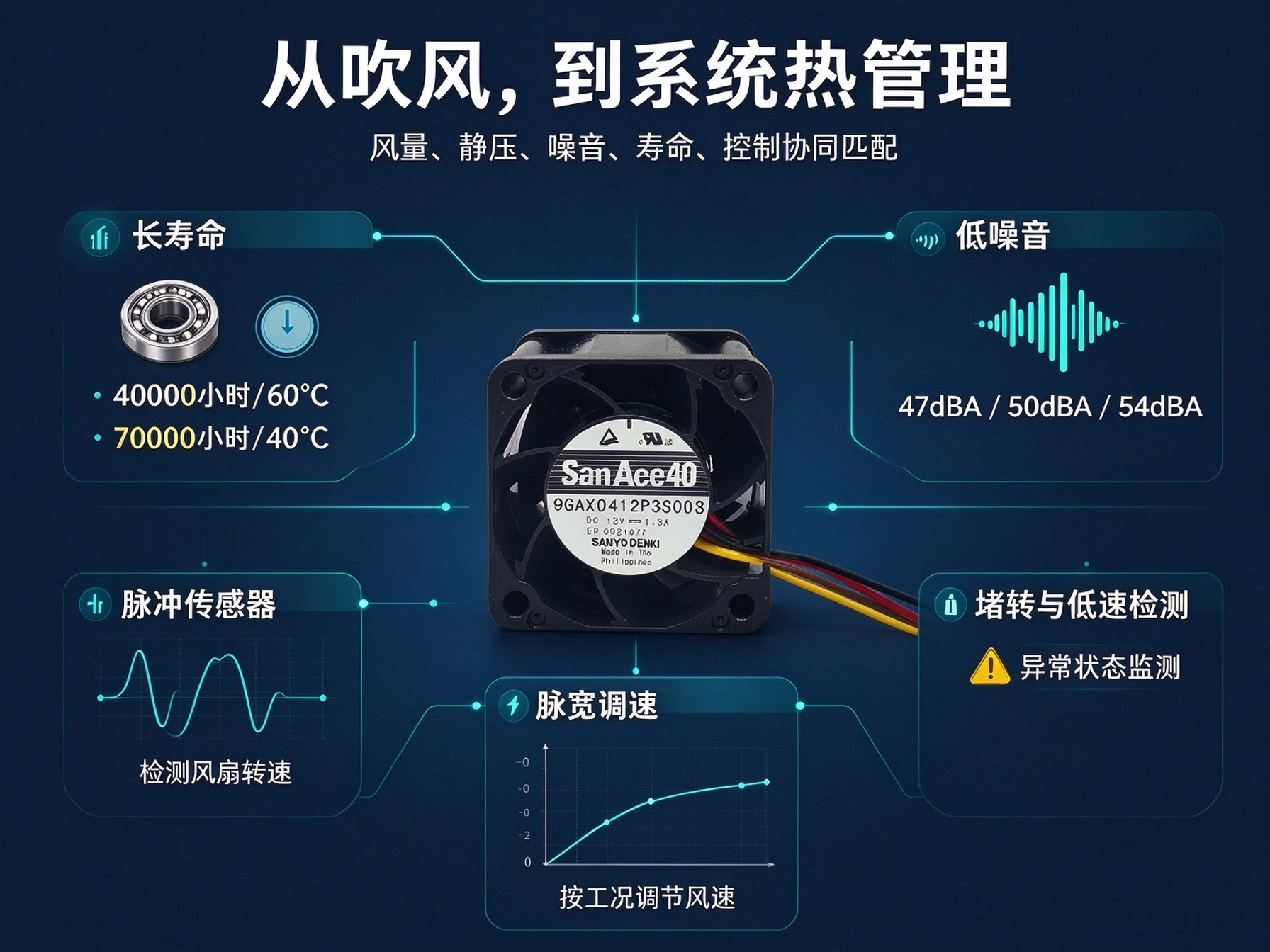
Oxygen concentrator cooling may appear to be a relatively simple fan application, but it is actually part of a complete thermal management chain:
Compressor operates continuously → Heat is generated → Internal temperature rises → Fan creates airflow → Heat is removed → Equipment temperature is controlled
Throughout this process, the fan may need to satisfy multiple requirements:
Airflow, static pressure, noise, power consumption, expected life, reliability, and control functions.
SANYO DENKI San Ace DC fans offer multiple frame sizes and performance levels, together with options such as pulse sensors, locked-rotor detection, low-speed detection, and PWM control.
These options allow engineers to build different cooling configurations around the actual requirements of the oxygen concentrator.
Therefore, a cooling fan is not simply an accessory inside an oxygen concentrator.
Its role is to provide:
A stable and effective path for removing the heat generated during continuous compressor operation.
The continuous supply of oxygen-enriched gas from an oxygen concentrator depends on the continuous operation of key components such as the compressor.
And continuous compressor operation inevitably generates heat.
If that heat is not effectively managed, stable equipment operation can become more challenging.
Therefore, oxygen concentrator cooling design should go beyond asking whether “the fan moves air.”
Engineers should also consider:
Is the airflow sufficient? Can the static pressure overcome system resistance? Is the noise level appropriate? Is power consumption acceptable? Is the expected life sufficient? Can fan operation be monitored and controlled?
This is the technical logic behind considering SANYO DENKI San Ace DC cooling fans for oxygen concentrator compressor cooling.
Continuous oxygen supply requires continuous thermal management.
From a single DC fan to the complete compressor thermal management system, effective cooling design ultimately aims to maintain a more stable thermal environment throughout long-term equipment operation.
jamicon cooling fan,AVC cooling fan,jentech cooling fan,AVC fan
Contact: Mr. Wang
Phone: 18148574796
Tel: 0755-23706799
Email: wmc@jentech.cn
Add: No. 28, Tongyuwu Industrial Zone, Kuikeng Community, Guanlan Street, Longhua District, Shenzhen City. 6th floor, Building 1, Hualangjia Industrial Park
 Click to inquire