Welcome: SANYO DENKI San Ace cooling fan product chain in China region
Language:
 ∷
∷

∷
 ∷
∷

In modern dental diagnosis, X-ray equipment plays an important role in transforming information that cannot be observed directly into clear dental images.
What appears to be simply “one beam of X-rays” actually depends on the coordinated operation of multiple systems, including the X-ray generator, high-voltage components, electronic circuits, control systems, and imaging components.
During operation, these electronic components continuously generate heat.
If that heat cannot be removed effectively, the temperature inside the equipment may rise, potentially affecting the operating conditions of electronic components and the overall stability of the equipment.
Therefore, for dental X-ray equipment, cooling is not simply an additional function—it is an important part of the overall thermal management system.
From an equipment design perspective, how can sufficient cooling be achieved within a compact space while also meeting requirements for reliability, noise, and continuous operation?
This is one of the key considerations when selecting cooling fans for X-ray generators.
Dental X-ray imaging uses X-ray radiation to capture information about teeth, roots, and surrounding structures.
Generating X-rays requires an X-ray generator and associated electronic systems.
During operation, these systems generate heat. Under high-load or continuous operating conditions, heat can accumulate inside the equipment.
The basic process can be understood as:
Equipment operation → electronic components generate heat → internal temperature rises → heat needs to be removed effectively.
Insufficient cooling may result in:
❌ Continuous temperature increases in certain areas
❌ Electronic components operating in elevated-temperature conditions
❌ Changes in electrical characteristics caused by temperature fluctuations
❌ Heat accumulation inside the equipment
❌ Potential impact on long-term operating stability
For this reason, thermal management should be considered during the design of dental X-ray equipment, alongside imaging performance, equipment dimensions, electrical systems, and other key requirements.
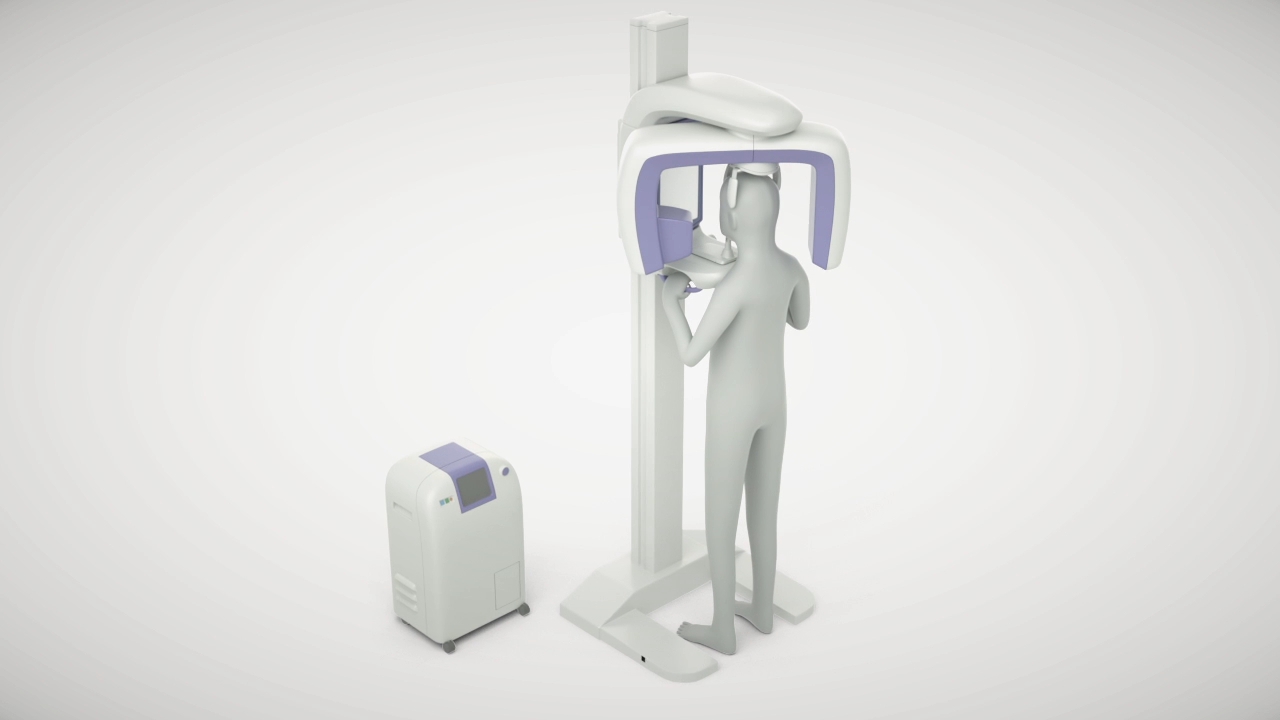
Dental equipment often needs to balance several requirements, including:
Compact size + low noise + reliability + effective cooling
This means that simply installing a fan and making it rotate is not enough.
Several factors need to be considered.
Dental X-ray equipment is often designed to be compact.
As a result, the available installation space for cooling fans can be limited, while the positions of air inlets and outlets may also be restricted by the equipment structure.
The cooling fan therefore needs to provide sufficient airflow within the available installation space.
Dental X-ray equipment is commonly used in dental clinics and treatment rooms where a relatively quiet environment is preferred.
Therefore, thermal management cannot focus only on cooling capacity.
Designers may also need to consider:
fan noise + vibration + airflow design
Simply increasing fan speed may increase airflow, but it can also increase operating noise.
The challenge is to establish an appropriate balance between cooling performance and acoustic requirements.
Dental X-ray equipment is professional diagnostic equipment and is expected to operate reliably during repeated use.
The cooling fan therefore should not be selected based solely on its initial airflow.
Designers may also need to evaluate:
Fan reliability
Bearing system
Motor characteristics
Vibration
Operating temperature
Expected service life
Cooling performance over time
The cooling fan itself is an important component of the equipment's thermal management system.
A reliable fan provides a stable foundation for reliable cooling.
When selecting a cooling fan, one of the first specifications people often look at is:
Airflow.
However, airflow alone does not necessarily describe how effectively a fan will cool an actual piece of equipment.
Once a fan is installed inside equipment, air may need to pass through:
air inlets → filters → heat-generating components → internal structures → air outlets
All of these structures can create airflow resistance.
This is where another important specification becomes relevant:
Simply put:
Airflow indicates how much air a fan can move, while static pressure describes the fan's ability to maintain airflow when resistance is present.
If the equipment has a narrow airflow path, filters, or other internal resistance, the fan's free-air airflow rating alone may not accurately represent its actual cooling performance after installation.
Therefore, fan selection should consider:
System impedance + operating point + airflow + static pressure
as a whole.
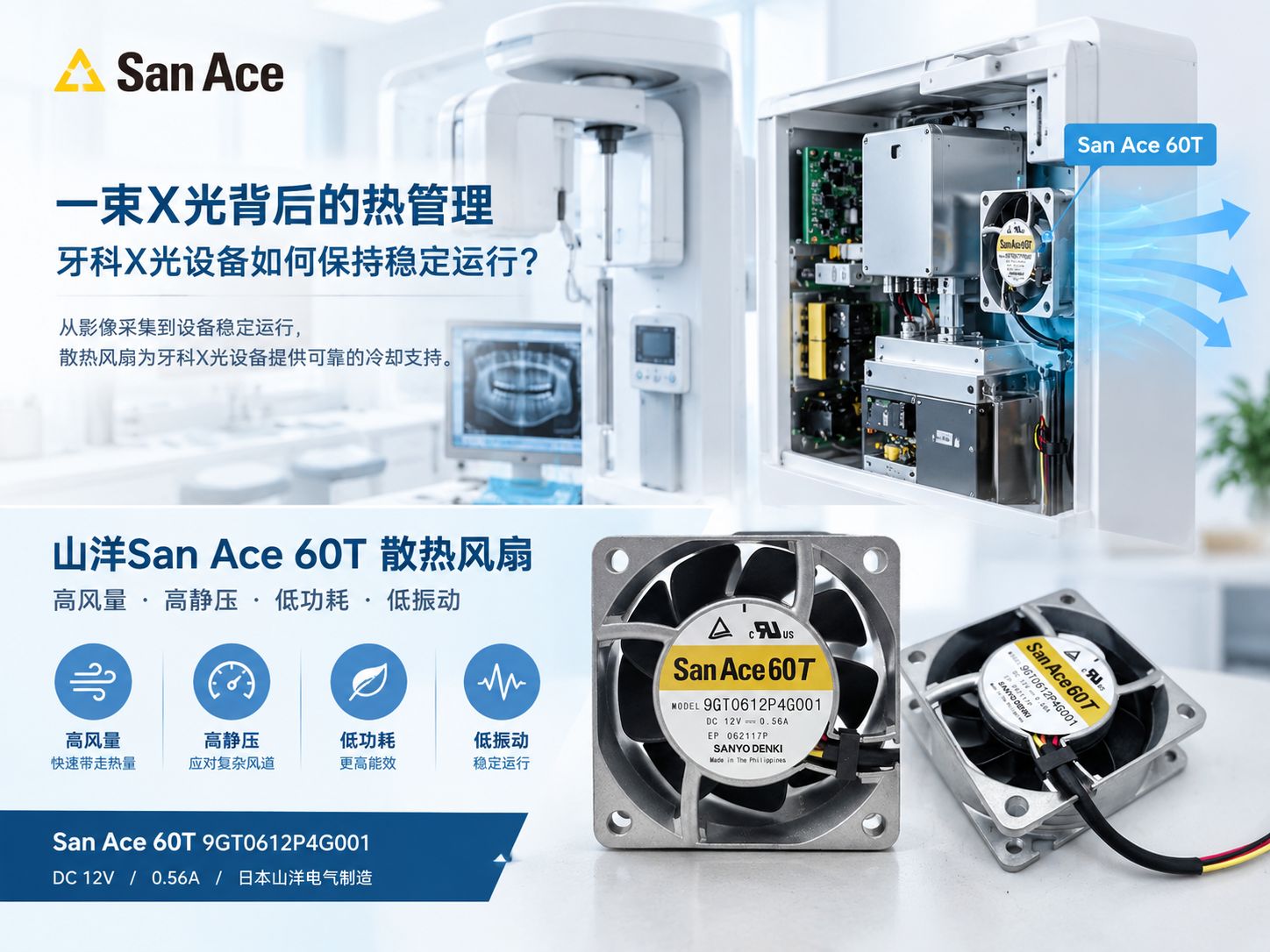
For applications such as X-ray generators, San Ace DC cooling fans can be used to help remove heat generated by internal electronic components.
San Ace DC cooling fans feature characteristics such as:
high airflow, high static pressure, low power consumption, and low vibration.
These characteristics allow designers to select suitable fan solutions according to the thermal management requirements of different types of equipment.
During product development, factors including impeller shape, motor characteristics, operating airflow, and expected service life are comprehensively considered to achieve the required cooling and reliability performance.
For X-ray equipment, this provides designers with more options when matching cooling fans to the equipment's heat sources and airflow paths.
Dental X-ray equipment does not have a single standardized internal structure.
Different equipment designs may have different:
Internal dimensions
Heat sources
Airflow paths
System resistance
Operating conditions
Therefore, a single fan specification cannot necessarily meet every application.
The focus may be:
Small size + sufficient airflow + appropriate static pressure
When installation space is limited, designers need to balance fan dimensions with cooling performance.
The focus may be:
High airflow + high static pressure + long-term reliability
When internal heat generation is relatively high, an effective airflow path becomes particularly important.
The focus may be:
Cooling performance + low noise + low vibration
This can be especially relevant in dental treatment environments.
Designers may consider an integrated approach:
Filter + fan + airflow path
San Ace also offers protection-related options, including resin filter kits, which can be selected according to the equipment's operating requirements.
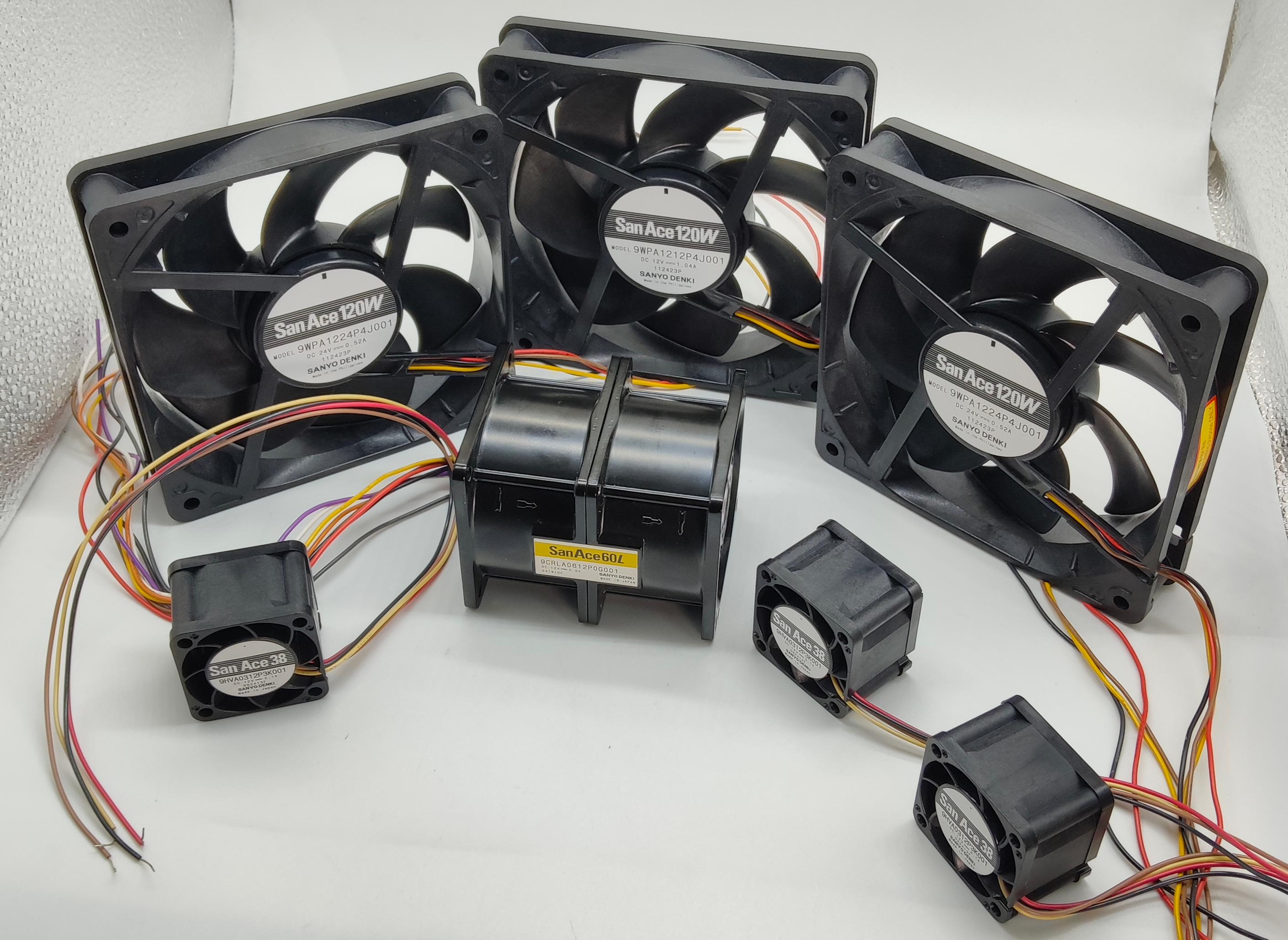
For professional equipment, what happens if a cooling fan stops operating?
It is not simply a matter of having “less airflow.”
If the equipment relies on forced-air cooling, a fan failure can reduce the cooling capability of the system.
Therefore, fan status monitoring can also be an important consideration in thermal management design.
San Ace DC cooling fans can offer a range of sensing and control functions.
Pulse signals can provide the equipment control system with information about fan operating speed.
This function can be used to detect conditions in which the fan stops rotating.
The system can detect when fan speed falls below a specified level.
PWM control enables fan speed to be adjusted according to equipment operating conditions.
For example:
Low thermal load → Lower fan speed
Higher thermal load → Greater cooling capacity
This approach can help equipment designers manage the relationship between cooling requirements, noise, and power consumption more flexibly.
For equipment that needs dynamic cooling control according to operating conditions, these functions can provide additional design flexibility.
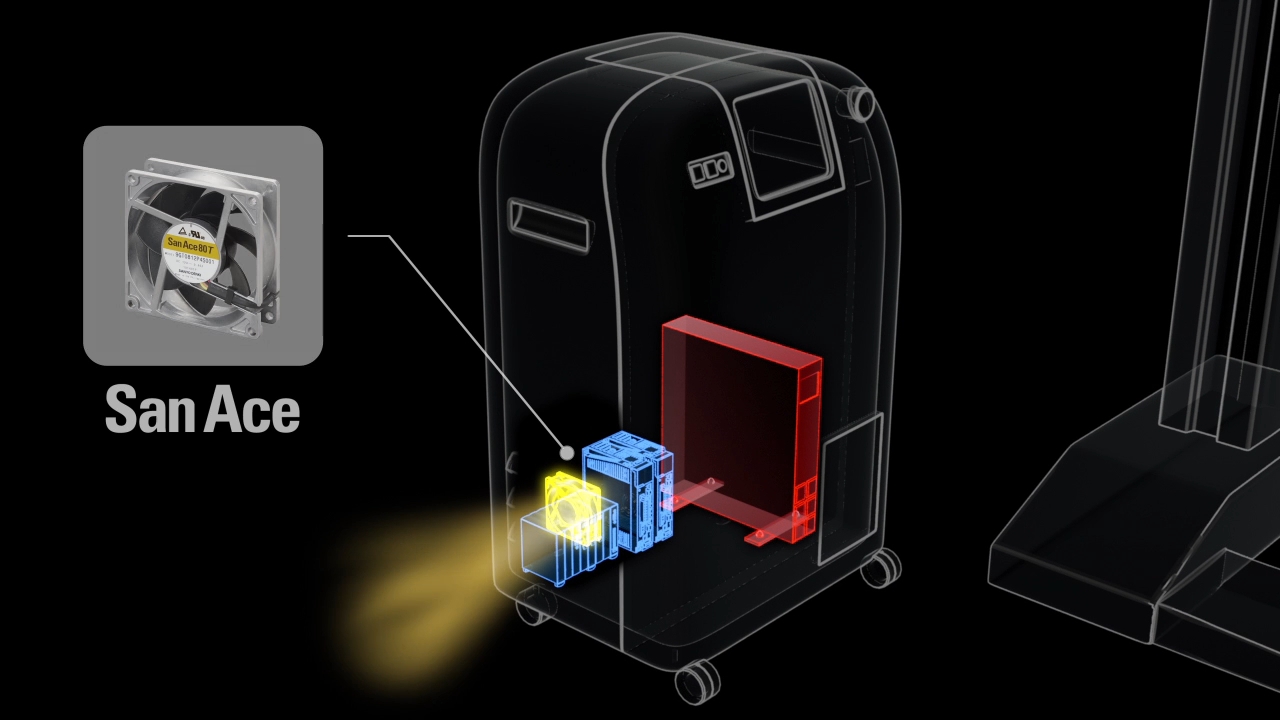
Dental X-ray equipment comes in different shapes and sizes.
Cooling fans therefore need to offer a broad range of dimensions and performance levels.
The San Ace DC Cooling Fan lineup includes more than 80 frame sizes, with various airflow and static pressure characteristics.
Available product categories include:
DC Fan
Low Power Consumption Fan
Silent Fan
Splash Proof Fan
Oil Proof Fan
Long Life Fan
Counter Rotating Fan
Blower
For equipment manufacturers, a broad product lineup provides greater flexibility.
Instead of adapting one fan specification to every piece of equipment, designers can select a solution based on the equipment's structure, thermal requirements, installation space, and operating environment.
Effective equipment cooling is not determined by a single fan specification.
A complete thermal management system may involve:
Heat source → heat transfer → airflow path → fan → heat removal
If one part of this chain is inadequate, overall cooling performance can be affected.
For example, if heat cannot be effectively transferred from the heat-generating components to the cooling area, even a high-airflow fan may not deliver the expected result.
Similarly, if the airflow path is poorly designed, air may circulate inefficiently inside the equipment instead of carrying heat out.
Therefore, the cooling fan should be selected as part of the entire thermal management system, rather than considered as an isolated component.
This is a common misconception in equipment cooling.
It may seem logical to assume:
Higher airflow = better cooling
But actual equipment cooling depends on the fan's operating point.
For example, if internal airflow resistance is high, a fan with a high free-air airflow rating may not necessarily maintain the same airflow after being installed in the equipment.
The effective airflow under actual system conditions may therefore be significantly different from the free-air specification.
This is why fan selection should take into account:
Equipment heat generation
Target temperature rise
Airflow path
System impedance
Required airflow
Required static pressure
Installation space
Noise requirements
Expected service life
Control requirements
Converting fan specifications into an actual system operating point is a more meaningful approach to thermal design.
The cooling system may not be the most visible part of a dental X-ray device.
But inside the equipment, it can operate continuously whenever cooling is required.
When the system starts, captures images, or operates repeatedly, heat generated by electronic components needs to be effectively removed.
This gives thermal management an important characteristic:
It may not be noticed during normal operation, but its importance becomes clear when cooling performance is insufficient.
That is why thermal management should ideally be considered during the equipment development stage rather than treated as a problem to solve after excessive temperature rise occurs.
Behind an X-ray beam is much more than an X-ray generator and imaging system.
It involves power supplies, electronic components, control systems, mechanical structures, airflow design, and thermal management working together.
A cooling fan may be only one component of this system, but it plays an important role in circulating air and removing heat.
Reliable operation is the result of many engineering details working together.
For dental X-ray equipment manufacturers, thermal design can be approached through several key steps:
Understand the heat generation and operating conditions of key electronic components.
Estimate the required cooling capacity based on heat load, allowable temperature rise, and other thermal requirements.
Determine appropriate air intake, circulation, and exhaust routes.
Do not rely solely on free-air airflow. Consider the actual operating point within the equipment.
Consider noise, dust, service life, protection, sensing, and control requirements.
Speed detection, locked-rotor detection, and low-speed detection can provide additional information for equipment operation monitoring.
The primary purpose of dental X-ray equipment is to acquire high-quality diagnostic images.
But for the equipment to perform this task reliably, the heat generated inside the system also needs to be managed effectively.
From high airflow and high static pressure to low power consumption and low vibration, and from a broad range of frame sizes to fan speed sensing, locked-rotor detection, and PWM control, a cooling fan is no longer simply a component that “moves air.”
It is an important part of the equipment's thermal management system.
Behind every X-ray beam is a sophisticated electronic system. Behind reliable operation is effective thermal management.
San Ace DC Cooling Fans provide cooling support for applications such as X-ray generators, with a broad lineup of products, frame sizes, sensing functions, and control options to support different equipment cooling requirements.
For dental X-ray equipment manufacturers, an effective cooling solution is not simply about installing a fan. It requires comprehensive consideration of heat sources, airflow paths, system impedance, and fan operating points.
By managing heat effectively and establishing a reliable thermal management system, every imaging operation can be supported by a more stable cooling foundation.
jamicon cooling fan,AVC cooling fan,jentech cooling fan,AVC fan
Contact: Mr. Wang
Phone: 18148574796
Tel: 0755-23706799
Email: wmc@jentech.cn
Add: No. 28, Tongyuwu Industrial Zone, Kuikeng Community, Guanlan Street, Longhua District, Shenzhen City. 6th floor, Building 1, Hualangjia Industrial Park
 Click to inquire