Welcome: SANYO DENKI San Ace cooling fan product chain in China region
Language:
 ∷

∷
 ∷

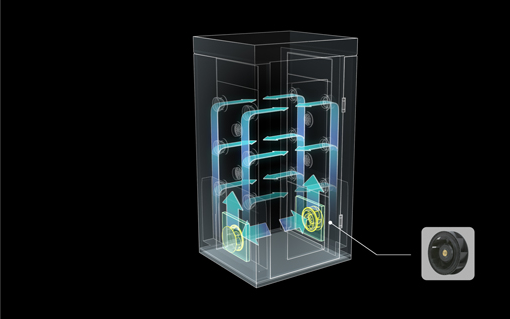
In cleanroom environments such as semiconductor manufacturing, electronics assembly, pharmaceutical production, and laboratories, air showers play an important role in reducing particle contamination before personnel or materials enter controlled areas. They use high-velocity clean air discharged through nozzles to remove some of the particles adhering to clothing and material surfaces, helping reduce the risk of contaminants entering the cleanroom.
When selecting a fan for an air shower, many engineers initially focus on airflow and rotational speed. However, the fan's ability to maintain the required airflow against the resistance of filters, ducts, and nozzles is equally important.
In particular, air showers equipped with HEPA filters require careful airflow system design. Air must pass through the filter and associated air passages before being discharged through the nozzles. The filter introduces pressure loss, which may increase as dust accumulates during operation. If the fan cannot provide sufficient static pressure, the actual airflow after installation may fall short of the design target, even if the fan has a high maximum airflow rating.
Therefore, fan selection should not be based solely on maximum free-air delivery. Engineers should evaluate fan performance at the actual operating point under system resistance.
For air-handling applications requiring a balance of airflow, static pressure, noise, and power consumption, SANYO DENKI San Ace centrifugal fans are worth considering as candidate solutions. Their specifications can help engineers narrow down suitable models according to airflow requirements, supply voltage, installation space, and operating conditions.
HEPA filters capture fine airborne particles through specialized filter media. As air passes through the media, pressure loss occurs. The fan must provide sufficient pressure to overcome this loss as well as the resistance of other components in the airflow system.
An air shower typically includes a fan, filter, supply and return air passages, and air nozzles. The combined resistance of these components determines the pressure required for the system to operate.
| Factor | Effect on the Airflow System | Selection Considerations |
|---|---|---|
| HEPA filter | Creates pressure loss as air passes through the filter media | Initial resistance, final resistance, and maintenance requirements |
| Duct design | Bends, cross-sectional changes, and local structures increase resistance | Duct length, cross-section, and layout |
| Nozzle design | Nozzle dimensions and quantity affect airflow distribution | Total airflow and target outlet velocity |
| Filter loading | Resistance may increase as dust accumulates | Maintenance intervals and replacement criteria |
| Fan operating point | Determines actual airflow and static pressure during operation | Fan performance curve and system resistance curve |
HEPA filter resistance is not the only factor that affects system performance. Ducts, grilles, and nozzles also contribute to pressure loss. Fan selection should therefore be based on the complete airflow system rather than filter specifications alone.

The SANYO DENKI San Ace centrifugal fan lineup includes products with different dimensions, voltage ratings, and performance characteristics. Engineers can use maximum static pressure, maximum airflow, power consumption, noise level, speed control, and protection ratings as initial screening criteria.
Among the DC centrifugal fan models in the supplied specifications, some offer maximum static pressure ratings of 830 Pa, 885 Pa, and up to 1,100 Pa.
In the splash-proof centrifugal ACDC fan lineup, certain models have maximum static pressure ratings of up to 1,200 Pa.
These figures are useful for preliminary comparisons of pressure capability. However, maximum static pressure does not represent the pressure available at the target airflow. The complete fan performance curve must be checked to confirm whether a model can meet the required operating point.
Maximum airflow indicates the upper airflow capacity under specified test conditions. Across the supplied models, maximum airflow ranges from less than 2 m³/min to more than 20 m³/min.
For an air shower, the required system airflow should be calculated based on nozzle quantity, nozzle outlet velocity, and airflow distribution requirements. A fan's maximum airflow rating should not be treated as the actual airflow delivered by the installed system.
Rated power consumption and noise level are also important selection criteria. Once the airflow and static pressure requirements have been satisfied, engineers should compare the power consumption and noise characteristics of candidate models.
For equipment operating over extended periods, reducing unnecessary power consumption can help lower operating costs. However, choosing a fan solely because it has a lower rated power may result in insufficient airflow or pressure.
All the models listed in the two supplied tables are marked as supporting PWM control. The actual control range and signal requirements should be verified against the specifications of each model.
The second lineup also includes splash-proof centrifugal ACDC fans with an IP56 protection rating. These models may be worth evaluating for equipment that requires a defined level of protection against dust and water.
However, IP56 does not mean that a fan is suitable for every cleaning process or liquid exposure condition, nor does it replace the need for an appropriate HEPA filtration system.

The following tables summarize representative models based on the supplied product data. They are intended for preliminary screening and comparison.
Maximum airflow and maximum static pressure generally correspond to different operating conditions. The two maximum values should not be interpreted as performance available simultaneously at a single operating point.
| Model | Size | Rated Voltage | Rated Power | Max. Airflow | Max. Static Pressure | Noise |
|---|---|---|---|---|---|---|
| 9TM24P4H01 | 100 mm | 24 V | 10.56 W | 1.77 m³/min | 560 Pa | 60 dBA |
| 9TN24P1H01 | 150 mm | 24 V | 14.9 W | 3.83 m³/min | 410 Pa | 59 dBA |
| 9TJ24P0H61 | 133 mm | 24 V | 28.8 W | 6.39 m³/min | 395 Pa | 61 dBA |
| 9TG24P0G01 | 175 mm | 24 V | 93.6 W | 14 m³/min | 885 Pa | 73 dBA |
| 9TGA24P0H001 | 175 mm | 24 V | 115 W | 15.3 m³/min | 830 Pa | 77 dBA |
| 9TGA48P0G001 | 175 mm | 48 V | 168 W | 17.6 m³/min | 1,100 Pa | 80 dBA |
| 9TP48P0G001 | 221 mm | 48 V | 132 W | 21 m³/min | 760 Pa | 74 dBA |
| 9TS48P0G001 | 225 mm | 48 V | 175.2 W | 28.1 m³/min | 861 Pa | 74.5 dBA |
These representative models demonstrate the range of airflow and static pressure ratings available within the San Ace centrifugal fan lineup.
For air shower applications, engineers should first establish the target operating point and then evaluate suitable models based on installation space, supply voltage, noise requirements, and fan performance curves.
| Model | Size | Rated Voltage | Rated Power | Max. Airflow | Max. Static Pressure | Noise | Protection Rating |
|---|---|---|---|---|---|---|---|
| 9ADW1TU23P0G001 | 190 mm | 230 V | 150 W | 16.5 m³/min | 1,200 Pa | 72 dBA | IP56 |
| 9ADW1TS23P0H001 | 225 mm | 230 V | 140 W | 22.3 m³/min | 760 Pa | 73 dBA | IP56 |
| 9ADW1TS23P0M001 | 225 mm | 230 V | 61 W | 16.9 m³/min | 440 Pa | 67 dBA | IP56 |
| 9ADW1TV23P0G001 | 250 mm | 230 V | 140 W | 26.5 m³/min | 650 Pa | 71 dBA | IP56 |
These models may be considered for air-handling equipment requiring AC power, higher airflow capacity, or a specified level of environmental protection.
Their suitability for a particular air shower must still be confirmed against the required operating point, installation conditions, and environmental requirements. An IP56 rating alone does not establish suitability for a specific application.

The following examples use hypothetical design requirements to illustrate how product specifications can support preliminary screening. They are not verified fan selections for specific air shower systems.
Assume a compact air shower uses a 24 V DC power supply and has limited installation space. The required airflow is relatively modest, but the resistance of the filtration system must still be considered.
Two models can be compared initially:
| Parameter | 9TM24P4H01 | 9TJ24P0H61 |
|---|---|---|
| Size | 100 mm | 133 mm |
| Rated Power | 10.56 W | 28.8 W |
| Max. Airflow | 1.77 m³/min | 6.39 m³/min |
| Max. Static Pressure | 560 Pa | 395 Pa |
| Noise | 60 dBA | 61 dBA |
The 9TM24P4H01 has a smaller size and lower rated power. Its maximum static pressure is 560 Pa, making it a candidate for evaluation in compact systems with relatively low airflow requirements.
The 9TJ24P0H61 offers a higher maximum airflow, but its maximum static pressure is lower.
This comparison illustrates an important selection principle: a higher maximum airflow does not necessarily indicate a greater ability to overcome system resistance.
If filter resistance is the main design challenge, engineers should compare the static pressure available at the required airflow rather than relying on maximum airflow ratings alone.
Assume an air shower requires substantial airflow while operating against resistance from HEPA filters and ducts. Engineers want to compare several models in the 175 mm size category.
The following models can be considered:
| Parameter | 9TG24P0G01 | 9TGA24P0H001 | 9TGA48P0G001 |
|---|---|---|---|
| Rated Voltage | 24 V | 24 V | 48 V |
| Rated Power | 93.6 W | 115 W | 168 W |
| Max. Airflow | 14 m³/min | 15.3 m³/min | 17.6 m³/min |
| Max. Static Pressure | 885 Pa | 830 Pa | 1,100 Pa |
| Noise | 73 dBA | 77 dBA | 80 dBA |
The 9TG24P0G01 has a maximum static pressure of 885 Pa and a rated power of 93.6 W. It can be included in the initial evaluation when both airflow capability and power consumption are important.
The 9TGA48P0G001 has a higher maximum static pressure rating of 1,100 Pa and a maximum airflow of 17.6 m³/min. It may be worth evaluating for systems with greater pressure requirements, although its rated power and noise level are also higher.
The key takeaway is that the highest maximum static pressure is not automatically the best choice. Engineers must verify the performance at the required operating point and assess power consumption and noise under the actual system conditions.
Assume an air-handling system uses a 230 V AC power supply and requires a specified level of dust and water protection. In this case, SANYO DENKI San Ace splash-proof centrifugal ACDC fans may be considered.
| Parameter | 9ADW1TU23P0G001 | 9ADW1TS23P0H001 | 9ADW1TS23P0M001 |
|---|---|---|---|
| Size | 190 mm | 225 mm | 225 mm |
| Rated Power | 150 W | 140 W | 61 W |
| Max. Airflow | 16.5 m³/min | 22.3 m³/min | 16.9 m³/min |
| Max. Static Pressure | 1,200 Pa | 760 Pa | 440 Pa |
| Noise | 72 dBA | 73 dBA | 67 dBA |
| Protection Rating | IP56 | IP56 | IP56 |
The 9ADW1TU23P0G001 has the highest maximum static pressure rating among these three models at 1,200 Pa. It can be included in the initial evaluation for systems with higher pressure requirements.
The 9ADW1TS23P0H001 offers a higher maximum airflow of 22.3 m³/min. It may be worth evaluating for systems requiring greater airflow capacity, subject to verification of its performance under the actual system resistance.
The 9ADW1TS23P0M001 has a rated power of 61 W and a noise level of 67 dBA. It may be considered for applications where power consumption and noise are important, provided its maximum static pressure rating of 440 Pa is sufficient for the system.
These comparisons are intended for preliminary selection only. Maximum static pressure, maximum airflow, rated power, and noise may be measured under different test conditions. They should not be used alone to determine actual system performance or operating efficiency.
Product specifications help engineers narrow down the candidate models, but final selection requires system-level calculations and verification.
Estimate the total airflow based on the number of nozzles, nozzle dimensions, and target outlet velocity.
For systems with multiple nozzles, airflow distribution should also be considered to avoid excessively high or low local velocities.
The total system resistance should account for pressure losses across the HEPA filter, ducts, grilles, nozzles, and other airflow components.
For the filter, both initial resistance and the recommended final resistance should be considered to evaluate how the operating point may change during the service life of the filter.
Match the fan performance curve with the system resistance curve to confirm whether the operating point meets the required airflow and pressure conditions.
Maximum static pressure and maximum airflow should not be combined as though they occur simultaneously. Rated rotational speed alone is also insufficient to determine suitability.
Check the rated voltage, rated power, installation dimensions, inlet and outlet orientation, and control method.
For applications requiring PWM speed control, confirm the control specifications and available speed range for the selected model.
After preliminary selection, test the complete system to verify airflow, nozzle outlet velocity, airflow distribution, operating noise, and power consumption.
For air showers using HEPA filters, validation should also address filtration, maintenance, and cleanroom performance requirements. Meeting the fan's specifications does not automatically mean that the complete air shower meets its required cleanliness performance.
The key to air shower fan selection is not simply choosing the highest airflow or maximum static pressure rating. The objective is to maintain the required airflow under the actual resistance of the complete system.
SANYO DENKI San Ace centrifugal fans are available in different sizes, voltage ratings, and performance levels, allowing engineers to evaluate potential solutions according to airflow requirements, system resistance, installation space, and power supply conditions.
For compact equipment using DC power, smaller DC centrifugal fans may be considered. For systems requiring greater airflow or pressure capability, models in the 175 mm, 221 mm, and 225 mm size categories can be evaluated. For equipment using AC power and requiring a specified protection rating, the corresponding IP56 splash-proof centrifugal ACDC fan models may be worth considering.
Final selection should be based on the actual operating point, the complete product specifications, and system-level test results. Proper matching of the fan, filter, ducts, and nozzles helps achieve the required air shower performance while balancing operational stability, noise, and power consumption.
Founded in 2010, Shenzhen JENTECH Electronics Co., Ltd. specializes in cooling fans and provides product selection and application support for industrial equipment, communication systems, medical devices, and new energy applications.
As a China strategic partner for SANYO DENKI San Ace fans, JENTECH supports customers with product information, specification consultation, and application matching for San Ace axial fans and centrifugal fans.
For air showers, cleanrooms, and air circulation systems equipped with HEPA filters, fan selection requires more than checking maximum airflow. Filter resistance, duct design, the actual operating point, noise level, and power consumption must also be considered. JENTECH can help customers evaluate suitable San Ace fan models based on their equipment requirements and operating conditions.
For San Ace centrifugal fan specifications, performance curves, or application-specific selection support, please contact Shenzhen JENTECH Electronics Co., Ltd. for further product and technical information.
台湾jamicon风扇、San Ace山洋散热风扇,AVC风扇,jentech风扇
Contact: Mr. Wang
Phone: 18148574796
Tel: 0755-23706799
Email: wmc@jentech.cn
Add: No. 28, Tongyuwu Industrial Zone, Kuikeng Community, Guanlan Street, Longhua District, Shenzhen City. 6th floor, Building 1, Hualangjia Industrial Park
 Click to inquire