SANYO DENKI San Ace 9BMB24K201 24V 9733 DC Blower Fan
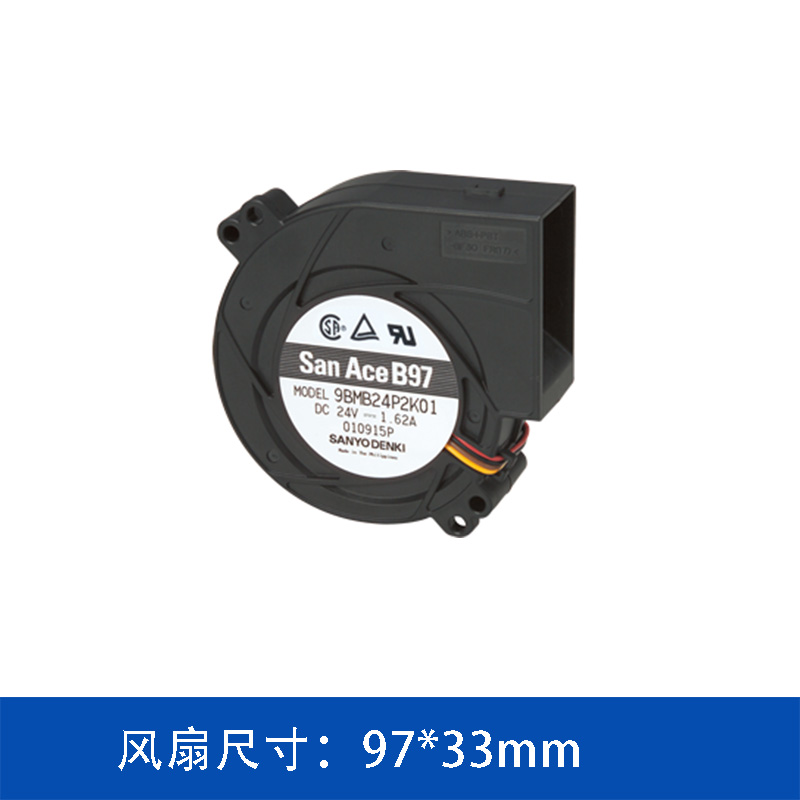
The SANYO DENKI San Ace 9BMB24K201 is a 24V DC blower fan designed for electronic equipment that requires a combination of concentrated airflow and high static pressure.
With a compact 97 × 97 × 33 mm form factor, this San Ace blower provides a maximum airflow of 56.8 CFM and maximum static pressure of 1,280 Pa. Its performance makes it suitable for cooling applications where airflow resistance is relatively high and conventional axial fans may not provide sufficient airflow through the system.
Key Specifications of 9BMB24K201
The main specifications of the San Ace 9BMB24K201 are:
|
Parameter
|
Specification
|
|
Model
|
9BMB24K201
|
|
Product Type
|
DC Blower
|
|
Brand
|
SANYO DENKI San Ace
|
|
Size
|
97 × 97 mm
|
|
Thickness
|
33 mm
|
|
Rated Voltage
|
24 V DC
|
|
Rated Current
|
1.62 A
|
|
Rated Power
|
38.88 W
|
|
Rated Speed
|
6,850 min-1
|
|
Maximum Airflow
|
1.61 m³/min / 56.8 CFM
|
|
Maximum Static Pressure
|
1,280 Pa / 5.14 inchH3O
|
|
Noise Level
|
66 dBA
|
|
Sensor
|
Pulse Sensor
|
|
PWM Control
|
Yes
|
|
Expected Life
|
40,000 h at 60°C / 70,000 h at 40°C
|
The specification data shows that the 9BMB24K201 belongs to the higher-performance models within the 97 × 33 mm San Ace blower range.
High Static Pressure for Compact Cooling Systems
One of the main characteristics of a blower fan is its ability to generate relatively high static pressure.
In many electronic devices, the cooling airflow does not travel through an open environment. Instead, it has to pass through heatsinks, air filters, narrow ventilation channels, ducts, circuit boards and other internal structures.
These components create system impedance.
When system resistance increases, the actual airflow delivered by a fan can be considerably lower than its free-air airflow rating.
The 9BMB24K201 provides a maximum static pressure of 1,280 Pa, making it suitable for cooling systems where airflow needs to be maintained against relatively high resistance.
This is particularly relevant to compact equipment with limited internal space.
97 × 97 × 33 mm Blower Design
The 97 × 97 × 33 mm dimensions provide a useful balance between installation space and cooling performance.
Compared with a conventional axial fan, a blower can redirect airflow through its outlet. The airflow direction is approximately 90 degrees from the intake direction, which provides additional flexibility when designing the internal airflow path of electronic equipment.
This can be useful when the available installation space does not allow a conventional axial fan to be positioned directly in line with the required airflow direction.
For equipment designers, this means that the blower can be integrated into a more compact airflow architecture without necessarily adding a separate external air duct.
6,850 min-1 Operating Speed
The rated speed of the 9BMB24K201 is 6,850 min-1.
At this operating point, the blower delivers:
-
56.8 CFM maximum airflow
-
1,280 Pa maximum static pressure
-
66 dBA noise level
-
38.88 W rated power
The relatively high rotational speed is part of the performance characteristics of this model and allows the blower to generate the pressure required for restricted airflow paths.
When integrating the fan into equipment, however, engineers should not select the model based solely on maximum airflow or rotational speed. The actual operating point should be evaluated against the system resistance curve.
PWM Control for Thermal Management
The 9BMB24K201 supports PWM control, allowing the fan speed to be adjusted according to the thermal requirements of the equipment.
This can be useful for systems with variable loads.
For example, an electronic system may operate at a relatively low thermal load during standby or light operation. Under these conditions, operating the blower continuously at maximum speed may not be necessary.
When internal temperature increases, PWM control can be used to increase the fan speed and provide additional cooling capacity.
This approach can help equipment designers balance:
-
Cooling performance
-
Power consumption
-
Acoustic performance
-
Fan operating speed
-
Thermal stability
The pulse sensor also provides rotational feedback, which can be used by the equipment controller to monitor fan operation.
Suitable Applications for 9BMB24K201
Because of its high-pressure airflow characteristics and compact 97 × 33 mm format, the San Ace 9BMB24K201 can be considered for a variety of high-density electronic cooling applications.
Typical application areas include:
Servers and IT Equipment
Servers contain processors, power conversion components, memory and other heat-generating devices within a relatively compact enclosure.
Airflow resistance can become significant when the cooling air needs to pass through heatsinks and densely packed components. A high-static-pressure blower can therefore be considered when designing these cooling paths.
Communication and Network Equipment
Communication equipment and network devices often require continuous operation while maintaining a compact enclosure.
The 9BMB24K201 can be used where concentrated airflow is required around high-temperature components or through restricted internal ventilation paths.
Energy Storage Systems
Energy storage equipment incorporates power electronics, control systems and other heat-generating components.
Depending on the enclosure design and airflow path, cooling air may need to pass through relatively narrow channels. A blower with higher static pressure can provide an alternative to conventional axial fan arrangements.
Industrial Electronic Equipment
Industrial controllers, power supplies, control cabinets and other electronic systems may also require forced-air cooling.
The compact 97 × 97 × 33 mm footprint provides additional flexibility where installation space is limited.
9BMB24K201 Selection Considerations
For equipment engineers, several parameters should be evaluated before selecting the 9BMB24K201.
1. Check the System Operating Point
The maximum airflow of 56.8 CFM is a fan performance value measured under specific test conditions. It does not necessarily represent the airflow that will be obtained after installation.
The equipment's resistance should be considered together with the fan's P-Q performance curve.
2. Consider Static Pressure
For systems containing dense heatsinks, filters, narrow ducts or restricted ventilation openings, static pressure can be more important than free-air airflow.
The 1,280 Pa maximum static pressure of the 9BMB24K201 provides substantial pressure capability for compact cooling systems.
3. Allow for Acoustic Requirements
The specified noise level is 66 dBA.
For industrial and enclosed electronic equipment, this may be acceptable depending on the installation environment. For applications requiring lower acoustic output, the operating speed can be evaluated together with the thermal requirements and PWM control strategy.
4. Verify the Power Supply
The model is designed for 24 V DC operation, with a rated current of 1.62 A and rated power of 38.88 W.
The equipment power supply and control circuit should therefore be designed with appropriate capacity and operating margin.
San Ace 9BMB24K201 at a Glance
The SANYO DENKI San Ace 9BMB24K201 combines a compact 97 × 97 × 33 mm blower structure with relatively high airflow and static pressure performance.
Its main characteristics include:
-
24 V DC operation
-
6,850 min-1 rated speed
-
56.8 CFM maximum airflow
-
1,280 Pa maximum static pressure
-
66 dBA noise level
-
PWM speed control
-
Pulse sensor feedback
-
40,000 hours expected life at 60°C
-
70,000 hours expected life at 40°C
For servers, communication equipment, energy storage systems and other compact electronic devices, the model can be evaluated when the cooling system requires high static pressure within a limited installation space.
The key to selecting this type of blower is not simply choosing the model with the largest airflow rating. Instead, the fan performance should be matched to the equipment's actual airflow resistance, heat load, available installation space, acoustic requirements and control strategy.
 ∷
∷





 Click to inquire