SANYO DENKI San Ace 9BMB24P2S01: 24V 9733 DC Blower for Compact Cooling Systems
As electronic equipment continues to become smaller and more densely integrated, the cooling system must often work within a limited mechanical space while maintaining a controlled airflow path.
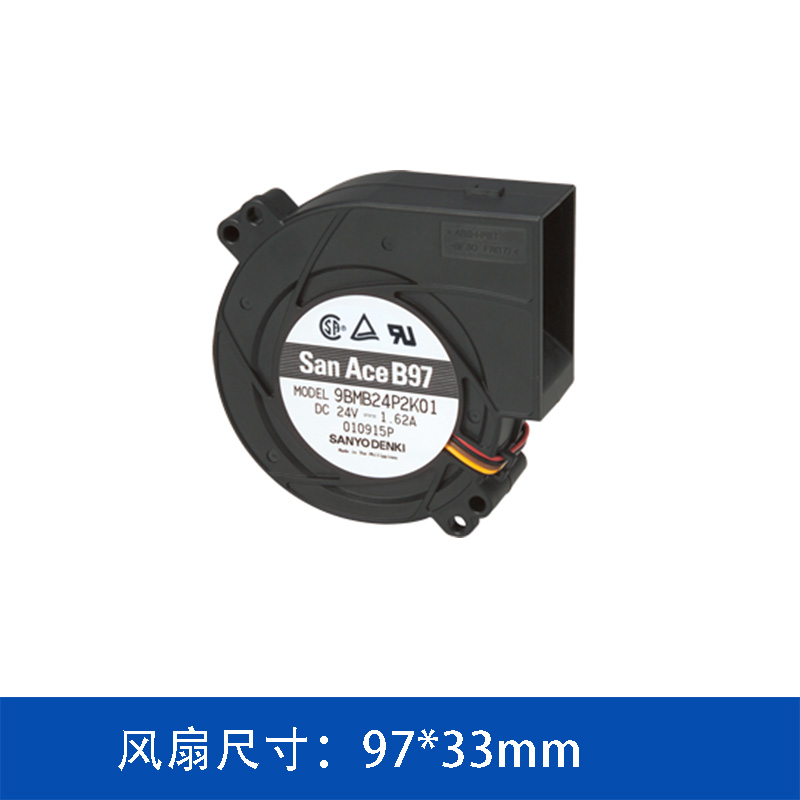
The SANYO DENKI San Ace 9BMB24P2S01 is a compact 97 × 33 mm, 24V DC blower designed for this type of thermal management requirement. With a rated power of 16.8 W, a rated speed of 5250 min⁻¹, maximum airflow of 43.1 CFM and maximum static pressure of 610 Pa, the model provides a balanced cooling configuration for equipment that requires forced airflow without moving into the higher-output classes of the 9733 blower lineup.
The model also incorporates PWM control and a pulse sensor, allowing it to be integrated into equipment that requires both variable-speed cooling and fan-status monitoring.
1. Compact 97 × 33 mm Form Factor
The 9BMB24P2S01 is designed around a 97 mm × 33 mm package.
For equipment engineers, the physical dimensions of a cooling component can be just as important as airflow performance. Internal space may already be occupied by PCBs, heat sinks, power components, connectors and structural supports.
The compact blower format allows the cooling system to be integrated into relatively restricted spaces.
Another characteristic of the San Ace blower configuration is its airflow direction. Air is discharged approximately 90 degrees from the intake direction, which can make it easier to construct an internal cooling route when a conventional straight-through axial fan arrangement is difficult to implement.
2. 24V DC Operation
The 9BMB24P2S01 operates from a 24V DC rated supply.
Its rated current is 0.7 A, with a rated power consumption of 16.8 W.
A 24V DC fan can be particularly convenient for industrial and electronic equipment that already uses a 24V control or auxiliary power architecture.
Potential equipment categories include:
-
Industrial control systems
-
Communication equipment
-
Network devices
-
Electronic controllers
-
Power supplies
-
Industrial automation equipment
-
Compact computing equipment
-
Storage systems
Using the same DC voltage architecture for the cooling subsystem can help simplify equipment-level power design.
3. 43.1 CFM Maximum Airflow
The maximum airflow of the 9BMB24P2S01 is 1.22 m³/min, equivalent to 43.1 CFM.
This provides a useful airflow capacity for compact electronic cooling applications.
It is important, however, to distinguish the maximum airflow specification from the actual airflow inside the final product.
Once a blower is installed, airflow is affected by:
-
Heat sink resistance
-
Filter pressure loss
-
Ventilation openings
-
Internal duct geometry
-
Protective grilles
-
Component density
-
Exhaust restrictions
Therefore, the final cooling performance depends on the complete system rather than the fan's free-air airflow rating alone.
4. 610 Pa Maximum Static Pressure
The 9BMB24P2S01 provides a maximum static pressure of 610 Pa, equivalent to approximately 2.45 inchH₂O.
This capability allows the blower to operate in systems where the airflow path has a certain level of resistance.
This is one reason blowers are often considered for applications where air needs to be directed through a defined internal route.
A simplified airflow path could be:
Air inlet → blower → heat sink → electronic components → exhaust
Each section of the path introduces resistance. The blower must therefore generate sufficient pressure to maintain useful airflow through the complete system.
For this reason, engineering selection should consider both airflow and static pressure.
5. 5250 min⁻¹ Rated Speed
The rated speed of the 9BMB24P2S01 is 5250 min⁻¹.
Within the 9733 product family, different models are available at different speed and power levels. This gives equipment designers the opportunity to match cooling performance more closely to the actual thermal requirement.
The 9BMB24P2S01 occupies a moderate performance position, providing:
-
5250 min⁻¹ rated speed
-
43.1 CFM maximum airflow
-
610 Pa maximum static pressure
-
16.8 W rated power
This combination can be useful when the system requires more controlled airflow than a low-output blower but does not require the higher power levels of the top-output models.
6. PWM Control for Variable Thermal Loads
The 9BMB24P2S01 supports PWM control.
This feature allows the blower speed to be managed by the equipment's control system instead of requiring the blower to operate continuously at a fixed condition.
For example, the cooling controller may respond to changes in:
-
Internal air temperature
-
Processor temperature
-
Power-device temperature
-
Equipment workload
-
Ambient temperature
The general control strategy can be represented as:
Low heat generation → lower blower speed
Increasing thermal load → increased blower speed
This approach can help the equipment maintain an appropriate cooling level under different operating conditions.
It can also be useful when the system designer wants to avoid operating the blower at maximum speed when the equipment is under a relatively light thermal load.
7. Pulse Sensor for Cooling-System Monitoring
In addition to PWM control, the 9BMB24P2S01 includes a pulse sensor.
The sensor can provide rotational feedback to the equipment controller.
This can be used for functions such as:
-
Rotation monitoring
-
Fan-speed feedback
-
Fan-failure detection
-
System alarms
-
Preventive maintenance
-
Cooling-system diagnostics
For equipment intended for long periods of continuous operation, fan monitoring can be an important part of the overall thermal protection strategy.
If the expected pulse signal is lost or falls outside the normal range, the equipment controller can potentially identify an abnormal cooling condition before excessive component temperature occurs.
8. Why Static Pressure Matters in Compact Equipment
One common mistake in cooling-system selection is comparing fans only by maximum airflow.
Consider two different situations.
In an open test environment, a fan may produce a high airflow value. However, when the same fan is installed behind a filter and heat sink, the airflow can decrease substantially.
This happens because the actual system introduces resistance.
A useful simplified relationship is:
Fan performance + system resistance = actual operating point
Therefore, engineers should evaluate the blower performance curve together with the pressure-loss characteristics of the equipment.
The 610 Pa maximum static pressure of the 9BMB24P2S01 provides a useful reference when assessing whether the blower is suitable for a restricted airflow path.
9. Potential Applications
The 9BMB24P2S01 can be considered for a variety of compact electronic and industrial cooling applications.
Industrial Control Equipment
Control systems can contain processors, power supplies and communication modules within a relatively small enclosure. A compact blower can provide forced airflow through a defined cooling route.
Communication Equipment
Network and communication equipment often uses densely arranged electronic components. A blower can help direct airflow through heat sinks and internal airflow channels.
Power Supply Equipment
Power supplies and converters can generate significant heat during continuous operation. Forced-air cooling may be required when passive heat dissipation is insufficient.
Industrial Automation
Industrial automation controllers and electronic modules can require reliable thermal management while operating continuously. The 24V configuration can also fit common industrial DC power architectures.
Compact Electronic Devices
Where the available installation area is restricted, the 97 × 33 mm form factor provides an option for integrating forced-air cooling without requiring a large axial fan footprint.
10. 9BMB24P2S01 Technical Specifications
|
Parameter
|
Specification
|
|
Model
|
9BMB24P2S01
|
|
Brand
|
SANYO DENKI / San Ace
|
|
Product type
|
DC Blower
|
|
Size
|
97 × 33 mm
|
|
Rated voltage
|
24 V DC
|
|
Rated current
|
0.7 A
|
|
Rated power
|
16.8 W
|
|
Rated speed
|
5250 min⁻¹
|
|
Maximum airflow
|
1.22 m³/min
|
|
Maximum airflow
|
43.1 CFM
|
|
Maximum static pressure
|
610 Pa
|
|
Maximum static pressure
|
2.45 inchH₂O
|
|
Noise
|
59 dBA
|
|
Sensor
|
Pulse sensor
|
|
PWM control
|
Yes
|
|
Expected life
|
40,000 h at 60°C / 70,000 h at 40°C
|
11. How to Determine Whether This Blower Fits the Application
Before specifying the 9BMB24P2S01 in a new product, engineers should evaluate the cooling system as a whole.
Thermal load
First determine how much heat needs to be removed from the equipment.
Airflow requirement
Calculate the airflow required to maintain the desired temperature rise.
Pressure loss
Estimate the resistance introduced by heat sinks, filters, grilles, ducts and ventilation openings.
Operating point
Use the blower performance curve and system impedance curve to determine the expected airflow under actual operating conditions.
Control strategy
If the equipment experiences changing thermal loads, determine whether PWM control should be integrated into the system controller.
Monitoring
If fan failure detection is required, determine how the pulse sensor will be incorporated into the equipment's monitoring logic.
This engineering approach is more reliable than selecting a blower based solely on the maximum CFM specification.
12. Position Within the San Ace 9733 Range
The San Ace 9733 family provides several combinations of voltage, rotational speed, airflow and static pressure.
The 9BMB24P2S01 represents a moderate-output 24V configuration with:
-
16.8 W rated power
-
5250 min⁻¹ rated speed
-
43.1 CFM maximum airflow
-
610 Pa maximum static pressure
For applications that do not require the higher output of the 6850 min⁻¹ models, this performance level can provide a more appropriately matched cooling solution.
The correct model should ultimately be determined by the actual thermal load, system impedance, noise requirements, available power and control strategy.
13. Conclusion
The SANYO DENKI San Ace 9BMB24P2S01 is a compact 24V DC blower measuring 97 × 33 mm, offering 43.1 CFM maximum airflow and 610 Pa maximum static pressure.
Its 16.8 W rated power, 5250 min⁻¹ speed, PWM control and pulse sensor make it suitable for equipment that needs controlled forced-air cooling within a relatively compact installation space.
Rather than evaluating the blower only by its maximum airflow, engineers should consider the complete airflow path and determine the actual operating point under system resistance.
For industrial control equipment, communication systems, network devices, power electronics and compact electronic equipment, the 9BMB24P2S01 provides a balanced 24V blower configuration for applications where airflow direction, installation space and controlled cooling performance all need to be considered.
 ∷
∷





 Click to inquire