Welcome: SANYO DENKI San Ace cooling fan product chain in China region
Language:
 ∷

∷
 ∷

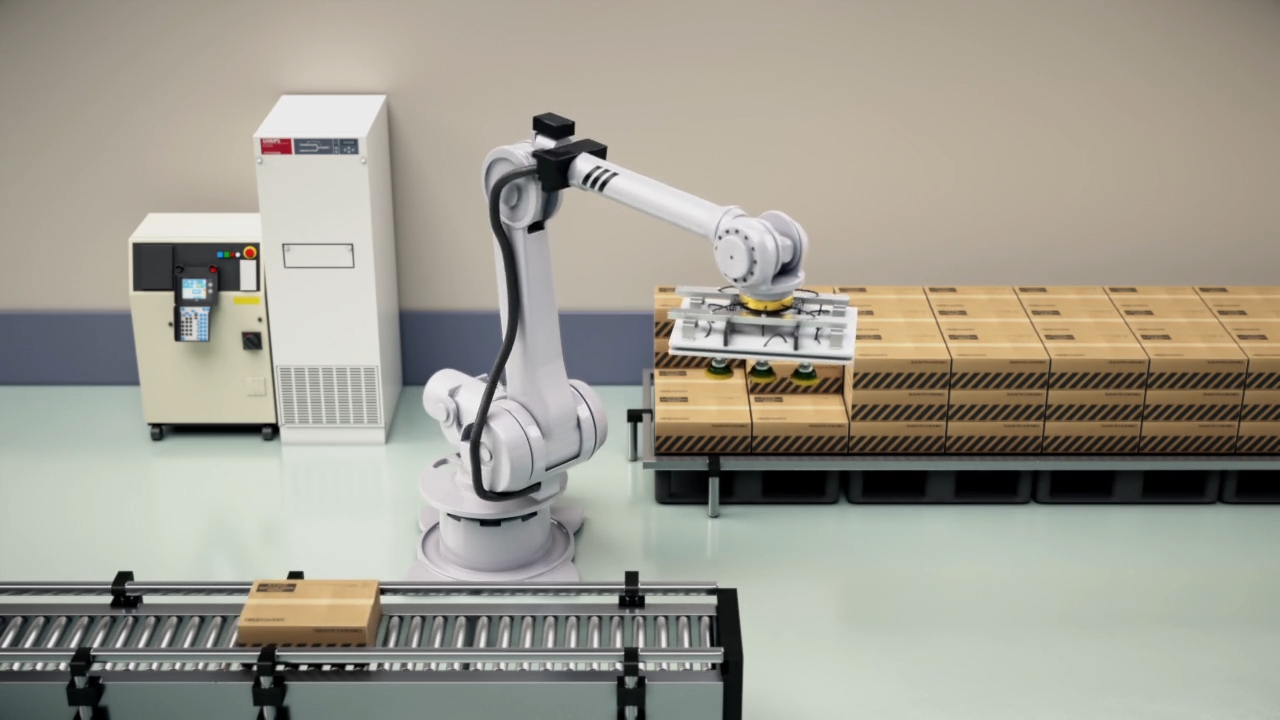
Palletizing robots play an increasingly important role in automated production lines. From carton handling and material picking to pallet stacking, these robots are widely used in food and beverage manufacturing, logistics and warehousing, chemical processing, building materials, and packaging industries.
While robotic arms are responsible for accurate picking, positioning, and stacking, the electrical control system behind them is equally important for maintaining stable equipment operation.
A typical palletizing robot control cabinet contains controllers, servo drives, inverters, power supply modules, and communication components. During extended operation, these electrical components continuously generate heat. The relatively enclosed cabinet structure, together with internal components, wiring, filters, and airflow restrictions, can make heat dissipation more challenging.
If the cooling design is inadequate, heat may accumulate around critical components, increasing operating temperatures and potentially affecting long-term equipment reliability.
So, how should cooling fans be selected for palletizing robot control cabinets?
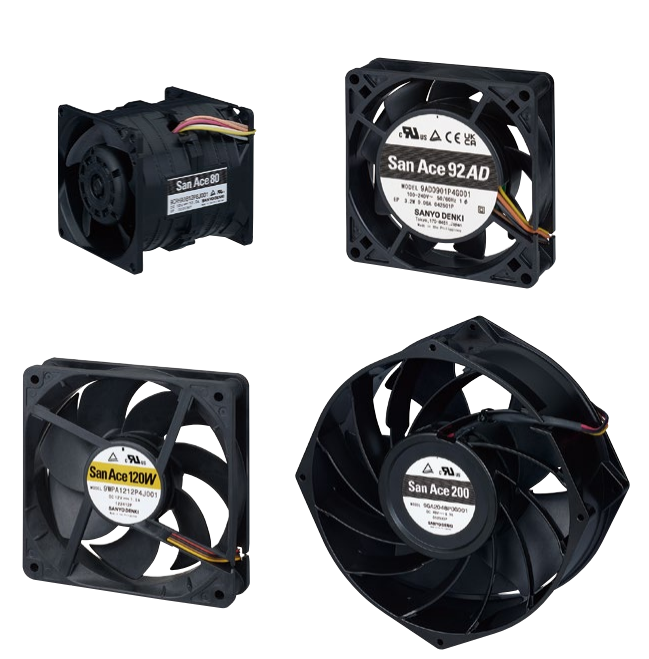
For equipment powered by AC mains, but requiring the low power consumption and long expected life associated with DC fan technology, SANYO DENKI San Ace ACDC Fans offer an alternative cooling solution worth considering.
A palletizing robot is more than a mechanical arm and gripper. Its movement control, positioning accuracy, speed regulation, and coordination with automated production equipment all depend on an electrical control system.
Several components inside the control cabinet require particular attention from a thermal management perspective.
Palletizing robots repeatedly perform picking, lifting, rotating, transferring, and placing operations.
Servo drive systems continuously regulate motor operation and convert electrical power to meet changing motion and load requirements.
Power semiconductor devices, capacitors, and associated circuits inside servo drives generate heat during operation. Without adequate heat dissipation, component temperatures may rise and affect long-term operating reliability.
Some palletizing systems also use inverters to control conveyor belts, motors, and auxiliary mechanisms.
Inverters generate heat during power conversion, while power supply modules also contribute to the overall thermal load.
When several heat-generating components are installed in the same cabinet, localized hot spots may develop. Therefore, airflow paths should be designed according to component placement and heat distribution.
Robot controllers, PLCs, industrial communication modules, and other control electronics may have relatively low individual power consumption. However, they still operate within specified temperature limits.
In compact control cabinets with insufficient airflow, hot air may become trapped around certain components, creating uneven temperature distribution.
For this reason, cabinet cooling should not simply be based on installing a fan with a high maximum airflow rating. Heat load, cabinet structure, airflow direction, and system resistance must all be considered.
Industrial cooling fans are commonly classified into AC fans and DC fans according to their power supply and motor drive technologies.
For some robot control cabinets powered by AC mains, using a conventional DC fan requires an appropriate DC power supply, together with consideration of its output capacity and wiring arrangement.
A San Ace ACDC Fan provides another approach.
It accepts AC power input and internally converts AC power to DC power. The fan then operates using DC motor drive technology.
Its basic operating principle can be summarized as:
AC Power Input + Internal AC-DC Conversion + DC Fan Drive Technology
Rather than simply combining an AC fan and a DC fan, SANYO DENKI integrates a compact AC-DC conversion circuit into the fan frame.
By optimizing the conversion circuit, motor drive circuit, and component selection, the design combines the convenience of AC power input with the advantages of DC fan technology.
For palletizing robot control cabinets, this design offers several potential benefits.
| Feature | Product Characteristics | Benefits for Control Cabinet Cooling |
|---|---|---|
| AC power input | 100–240 VAC rated input | Compatible with applicable 100 V and 200 V AC power systems |
| Internal AC-DC conversion | Integrated conversion circuit | Eliminates the need for a separate DC power supply dedicated to the fan |
| Low power consumption | Optimized conversion and motor drive circuits | Helps reduce fan operating energy consumption |
| High airflow and static pressure | Optimized impeller and frame design | Supports different cabinet airflow resistance conditions |
| Extended expected life | 60,000 hours at 60°C | Helps reduce fan replacement frequency |
| Sensor options | Low-speed and pulse sensor models | Enables fan monitoring according to system requirements |
It is important to note that an ACDC fan is not automatically a direct replacement for every DC fan. Actual selection must consider input voltage, mounting requirements, airflow, static pressure, control interfaces, and electrical safety requirements.
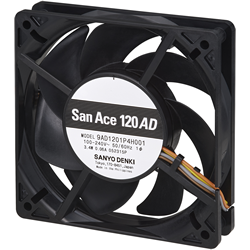
For robot control cabinets, industrial electrical enclosures, and other applications requiring continuous ventilation, the SANYO DENKI San Ace 120AD ACDC Fan series offers several speed and functional configurations.
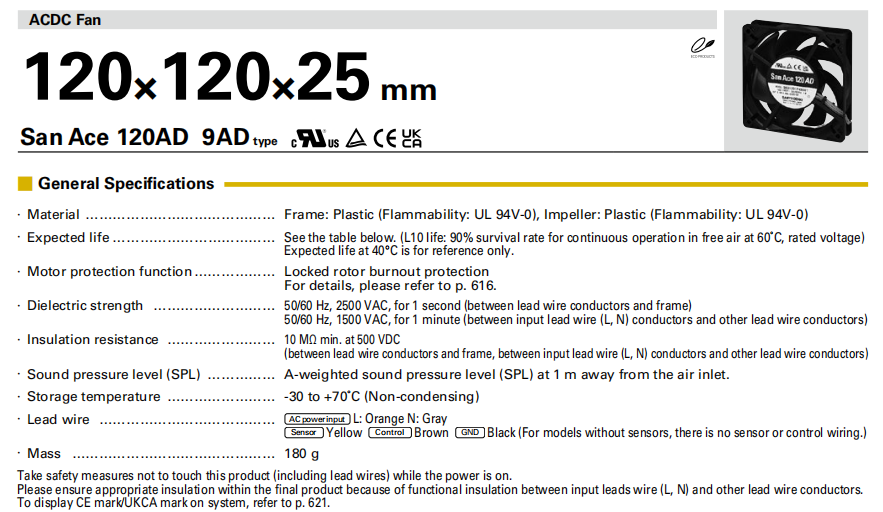
The series features a standard 120 × 120 × 25 mm axial fan format and a rated input voltage of 100–240 VAC.
Depending on cooling requirements, users can select models with different rated speeds, including 1,800, 2,250, and 3,000 min⁻¹.
Key product features include:
Wide AC input voltage: 100–240 VAC rated input, with an operating voltage range of 90–264 VAC.
Multiple speed options: 1,800, 2,250, and 3,000 min⁻¹.
High airflow and static pressure: Maximum airflow of 2.35 m³/min and maximum static pressure of 62 Pa.
Low power consumption: Rated power consumption ranging from 1.1 W to 3.4 W, depending on the model.
Extended expected life: 60,000 hours at 60°C and 90,000 hours at 40°C.
Functional options: Low-speed sensor, pulse sensor, and PWM control options are available on selected models.
The following table summarizes the key specifications of selected 120 × 120 × 25 mm models.
| Model | Rated Speed (min⁻¹) | Max. Airflow (m³/min) | Max. Airflow (CFM) | Max. Static Pressure (Pa) | Noise (dBA) | Rated Power (W) |
|---|---|---|---|---|---|---|
| 9AD1201H4002 | 3,000 | 2.35 | 83 | 62 | 40 | 3.4 |
| 9AD1201M4002 | 2,250 | 1.76 | 62 | 35 | 34 | 1.6 |
| 9AD1201L4002 | 1,800 | 1.41 | 49 | 22 | 26 | 1.1 |
All three models feature a rated input voltage of 100–240 VAC and an expected life of 60,000 hours at 60°C or 90,000 hours at 40°C.
These specifications demonstrate that the series provides different performance configurations rather than a single fixed airflow and speed option.
For palletizing robot control cabinets with multiple power devices, relatively high heat loads, or considerable airflow resistance, the high-speed model may be worth evaluating.
For cabinets with lower thermal loads and greater emphasis on noise and auxiliary power consumption, medium- or low-speed models may be more appropriate.
One important consideration: maximum airflow and maximum static pressure represent different endpoints of the fan performance curve. They cannot normally be achieved simultaneously.
Actual airflow should be determined from the operating point where the fan's P-Q curve intersects the system resistance curve.
In addition to speed and airflow performance, the 9AD1201 series offers different sensor and frame configurations.
| Model | Sensor Type | PWM Control | Ribbed Frame | Main Difference |
|---|---|---|---|---|
| 9AD1201H4002 | Without pulse sensor | No | Yes | 3,000 min⁻¹ basic configuration |
| 9AD1201H40021 | Without pulse sensor | No | No | Non-ribbed frame version |
| 9AD1201H4H001 | Low-speed sensor | No | Yes | Low-speed monitoring |
| 9AD1201H4H0011 | Low-speed sensor | No | No | Non-ribbed frame version |
| 9AD1201P4H001 | Pulse sensor | Yes | Yes | Pulse feedback and PWM control |
| 9AD1201P4H0011 | Pulse sensor | Yes | No | Non-ribbed frame version |
The term Ribbed indicates whether the fan frame includes reinforcing ribs. The ribbed and non-ribbed versions have different frame structures, so the mounting arrangement and mechanical compatibility should be checked before selection.
For palletizing robot control cabinets:
If basic ventilation is required without fan speed feedback, a model without a sensor may be considered.
If the control system needs to detect abnormal low-speed operation, a low-speed sensor model may be suitable.
If the control system requires pulse feedback and supports a compatible PWM interface, models such as 9AD1201P4H001 can be evaluated.
Low-speed sensors and pulse sensors perform different functions. PWM control is also available only on selected models. It should not be assumed that every ACDC fan supports speed adjustment.
During fan selection, engineers sometimes focus primarily on maximum airflow, assuming that a higher airflow rating always means better cooling.
However, once a fan is installed in a control cabinet, it no longer operates under unrestricted free-air conditions.
Servo drives, inverters, cables, filters, protective grilles, and internal partitions all create resistance to airflow.
The fan must overcome this resistance to maintain effective air circulation.
Therefore, when selecting a 120AD model, engineers should not rely solely on specifications such as 83 CFM or 62 Pa. The actual operating point is much more important.
The 9AD1201H4002 has a rated speed of 3,000 min⁻¹, a maximum airflow of 2.35 m³/min, and a maximum static pressure of 62 Pa.
Compared with medium- and low-speed models, it provides higher airflow and static pressure performance.
It is worth evaluating for control cabinets with relatively high heat loads or greater airflow resistance.
However, higher speed also results in higher rated power consumption and noise levels. These factors should be considered alongside cooling requirements.
The 9AD1201M4002 operates at 2,250 min⁻¹, with a maximum airflow of 1.76 m³/min, maximum static pressure of 35 Pa, and rated power consumption of 1.6 W.
For control cabinets with moderate thermal loads and relatively well-designed airflow paths, this model can be considered as a candidate.
Compared with the high-speed version, it offers lower rated power consumption and noise levels.
The 9AD1201L4002 operates at 1,800 min⁻¹, with a maximum airflow of 1.41 m³/min, maximum static pressure of 22 Pa, and rated power consumption of only 1.1 W.
For control cabinets with relatively low heat loads and low system resistance, this model may be worth evaluating.
However, if heat sources are concentrated or filter resistance is high, the actual airflow may be insufficient.
| Selection Factor | High Speed | Medium Speed | Low Speed |
|---|---|---|---|
| Representative Model | 9AD1201H4002 | 9AD1201M4002 | 9AD1201L4002 |
| Rated Speed | 3,000 rpm | 2,250 rpm | 1,800 rpm |
| Maximum Airflow | 83 CFM | 62 CFM | 49 CFM |
| Maximum Static Pressure | 62 Pa | 35 Pa | 22 Pa |
| Noise | 40 dBA | 34 dBA | 26 dBA |
| Rated Power | 3.4 W | 1.6 W | 1.1 W |
| Main Consideration | Thermal load and airflow resistance | Balance of performance and noise | Low power consumption and low noise |
These values are product specifications, not guaranteed cooling results inside a specific control cabinet.
Final selection should be validated through thermal load assessment, airflow analysis, and temperature-rise testing.
Beyond the fan specifications themselves, installation conditions and operating environments also influence cooling performance.
The 9AD1201 series has a rated input voltage of 100–240 VAC and an operating voltage range of 90–264 VAC, supporting 50/60 Hz AC power systems.
Before selection, verify the actual supply voltage, frequency, wiring arrangement, and electrical protection requirements.
Because the product connects directly to AC power, installation and maintenance must comply with applicable electrical safety standards. It should not be wired or handled in the same way as a conventional low-voltage DC fan.
The cabinet's air inlet and exhaust outlet should be arranged to prevent airflow short-circuiting.
If hot air is discharged and immediately drawn back into the cabinet, or if certain areas have insufficient airflow, even a fan with a high rated airflow may fail to reduce local temperatures effectively.
Palletizing robots are commonly used in packaging, food processing, building materials, and warehouse environments.
Different sites may expose control cabinets to dust, fibers, oil mist, and humidity.
If an air filter is installed at the cabinet inlet, its resistance should be considered, including the increase in resistance caused by dust accumulation.
Regular filter inspection and cleaning are also important.
In addition, the available specifications for the listed 9AD1201 models do not specify an IP protection rating. These models should not automatically be classified as waterproof or dustproof fans.
For applications with significant dust, moisture, or oil contamination, additional protection requirements should be confirmed and evaluated together with the cabinet enclosure and filtration design.
For automated equipment operating over extended periods, a fan malfunction, abnormal speed reduction, or insufficient airflow may gradually increase cabinet temperature.
If the control system requires fan operating feedback, models with low-speed sensors or pulse sensors can be evaluated.
The sensor output, electrical interface, signal level, and alarm logic must be compatible with the robot control system.
Selected SANYO DENKI San Ace 120AD models have the following expected life specifications:
60,000 hours at an ambient temperature of 60°C.
90,000 hours at an ambient temperature of 40°C.
For reference, under continuous operation at 24 hours per day:
60,000 hours is approximately 6.85 years.
90,000 hours is approximately 10.27 years.
However, expected life should not be interpreted as a guaranteed service period or warranty duration.
Ambient temperature, dust accumulation, installation conditions, and actual operating conditions can all influence service life.
For palletizing robots operating continuously, a maintenance plan covering fan inspection, filter cleaning, and operating status monitoring is still recommended.
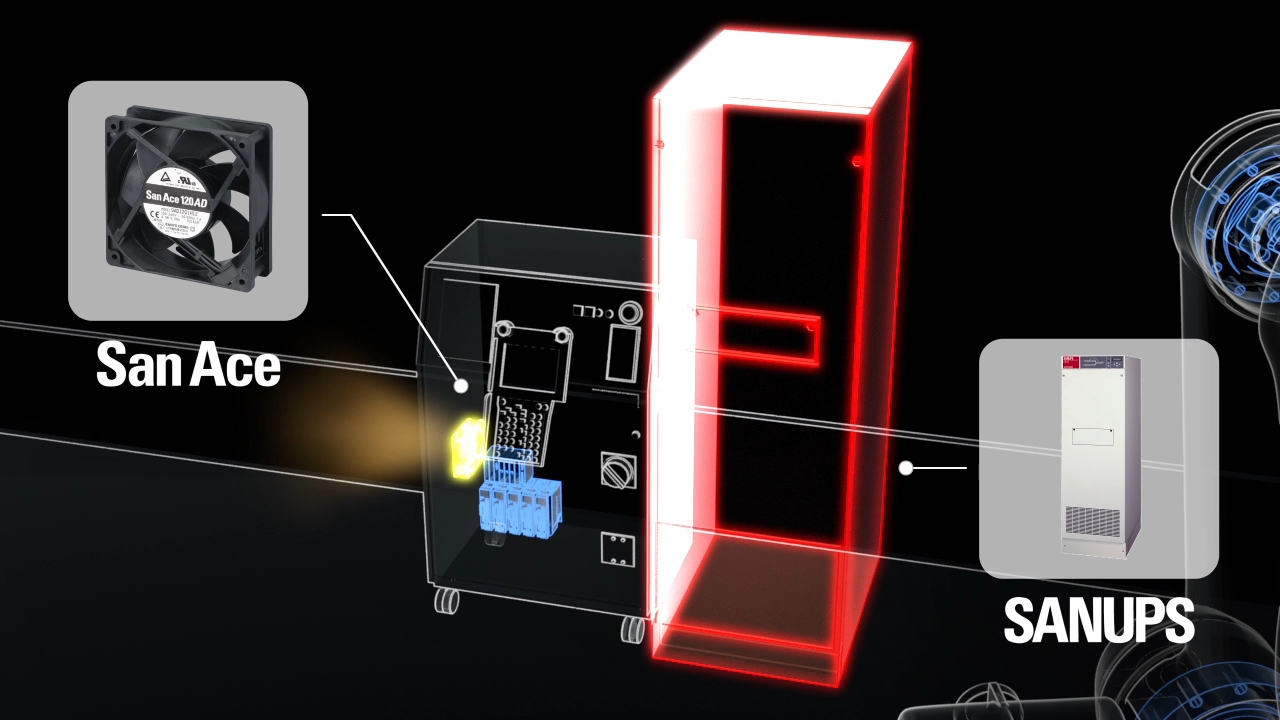
The value of ACDC fan technology is not limited to palletizing robot control cabinets.
For industrial equipment powered by AC mains that also requires the power efficiency, expected life, and installation convenience associated with DC fan technology, an ACDC solution may be worth evaluating.
| Equipment Type | Main Cooling Areas | Key Selection Considerations |
|---|---|---|
| Palletizing Robots | Robot control cabinets and drive systems | Continuous operation, airflow, and static pressure |
| Industrial Robotic Arms | Servo drives and electrical control cabinets | Thermal load and mounting space |
| Automated Packaging Machines | Control cabinets, inverters, and power modules | Continuous operation and low power consumption |
| Conveyor and Sorting Systems | Electrical controls and drive modules | Multi-device coordination and maintenance |
| Industrial Automation Lines | PLC control cabinets and electrical enclosures | Ventilation efficiency and operating reliability |
Whether an ACDC fan is suitable for a particular application still depends on the equipment's power architecture, thermal load, and airflow conditions.
For palletizing robots, industrial robotic arms, and automated production equipment, cooling fan selection involves much more than simply matching a mounting size.
Thermal sources, operating environments, airflow paths, power supply requirements, and long-term maintenance conditions all need to be considered.
Shenzhen JENTECH Electronics Co., Ltd. specializes in industrial thermal management and serves as an authorized distribution partner for SANYO DENKI San Ace cooling fans from Japan.
Through its long-standing cooperation with SANYO DENKI and stable original supply channels, JENTECH provides San Ace fan products and application-oriented selection support to customers in industrial automation, new energy, telecommunications, medical equipment, and other industries.
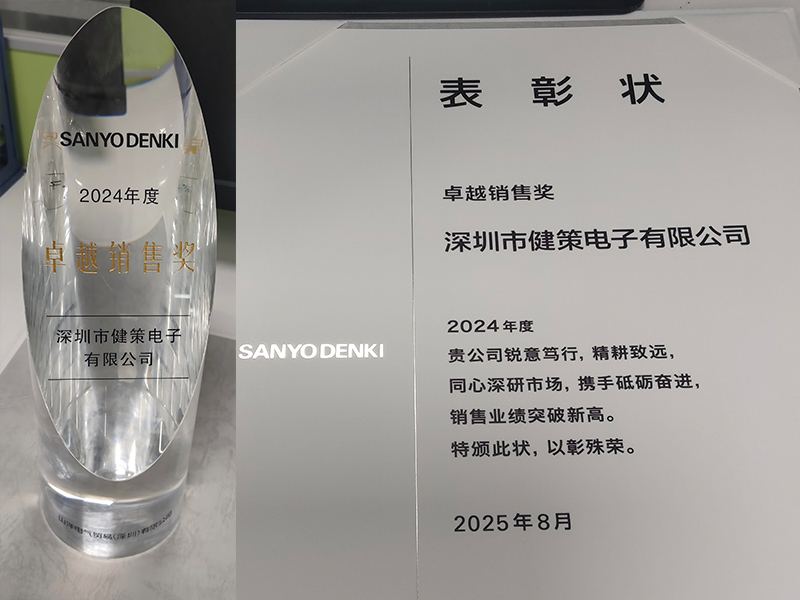
JENTECH has also received the SANYO DENKI 2023 Best Sales Award and 2024 Excellent Sales Award in recognition of its sales performance and cooperation.
For palletizing robot control cabinets and industrial automation equipment, JENTECH can assist customers with:
Selection of SANYO DENKI San Ace AC, DC, and ACDC axial fans.
Matching standard fan sizes, including 120 × 120 × 25 mm models, with cabinet installation requirements.
Evaluating airflow and static pressure based on thermal loads and system resistance.
Checking AC/DC power supply compatibility.
Matching low-speed sensors, pulse feedback, and PWM functions with control system requirements.
Product specification verification and cooling solution consultation.
If your palletizing robot control cabinet operates for extended periods, or you are looking for a cooling solution that combines the convenience of AC power input with the performance advantages of DC fan technology, the SANYO DENKI San Ace 120AD ACDC Fan series is worth evaluating.
Choosing the right cooling fan is not simply about moving air inside a control cabinet. More importantly, it is about establishing an effective airflow path to remove heat and support the stable operation of automated equipment.
jamicon cooling fan,AVC cooling fan,jentech cooling fan,AVC fan
Contact: Mr. Wang
Phone: 18148574796
Tel: 0755-23706799
Email: wmc@jentech.cn
Add: No. 28, Tongyuwu Industrial Zone, Kuikeng Community, Guanlan Street, Longhua District, Shenzhen City. 6th floor, Building 1, Hualangjia Industrial Park
 Click to inquire