SANYO DENKI San Ace 109BM12HC2-1: 12V 97×97×33mm DC Blower for Compact Equipment Cooling
When thermal management space is limited, the cooling fan needs to provide stable airflow without occupying excessive installation space or consuming unnecessary power. For compact electronic equipment, communication devices, control systems and other applications where operating noise and power consumption need to be considered together, a DC blower can provide a practical alternative to conventional axial fans.
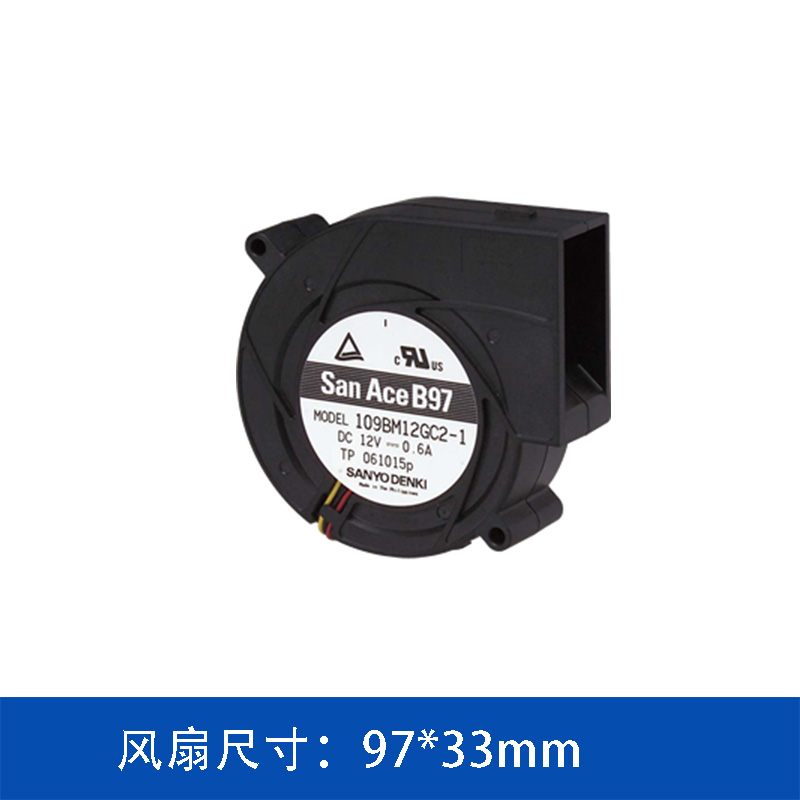
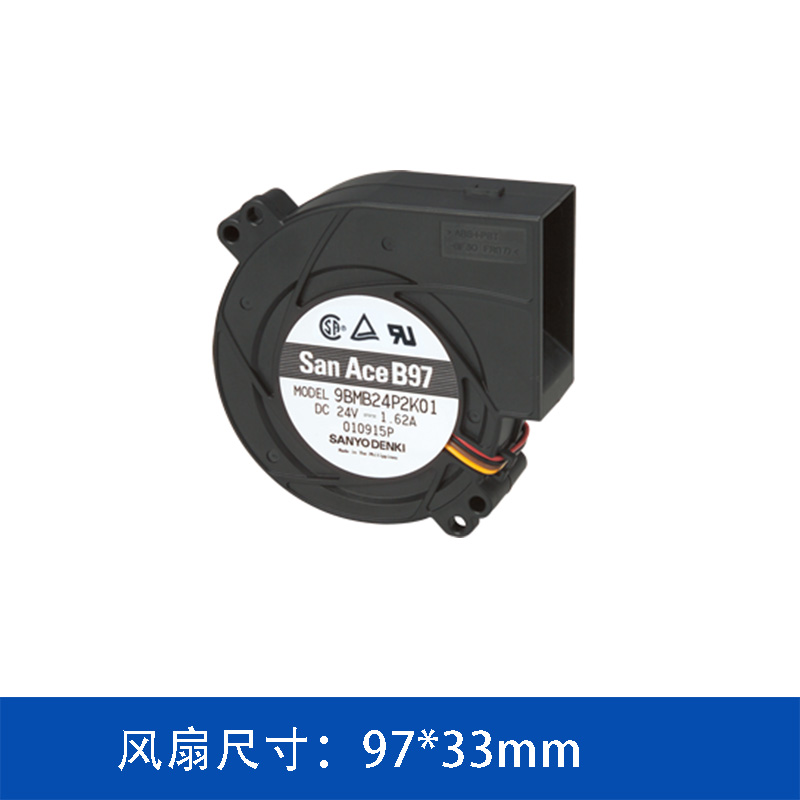
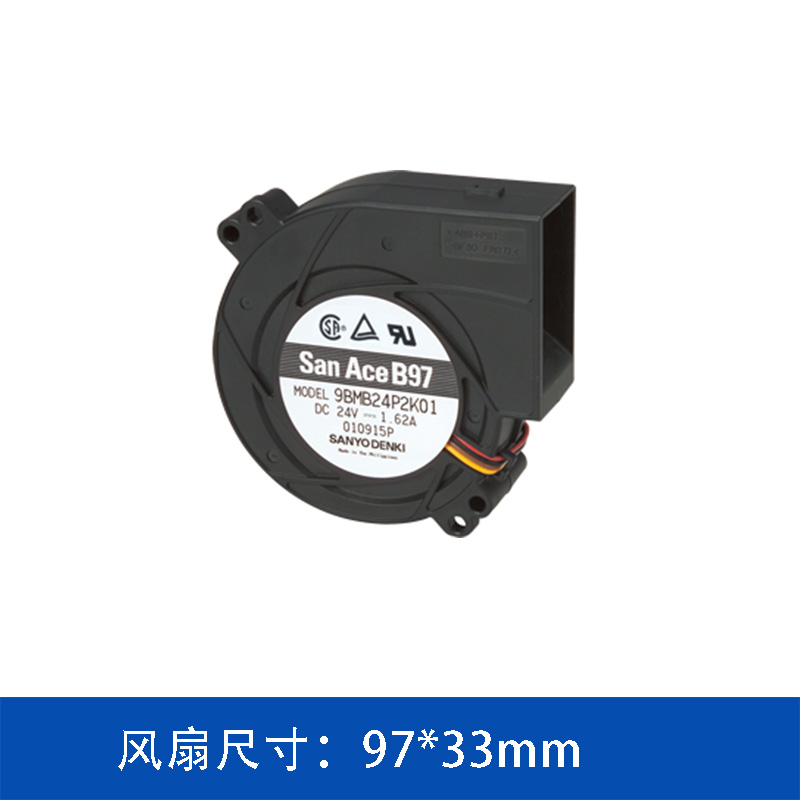
The SANYO DENKI San Ace 109BM12HC2-1 is a 97×97×33mm DC blower designed for this type of application. Operating from a 12V DC supply, this model provides a maximum airflow of 25.1 CFM and a maximum static pressure of 204 Pa, with a rated noise level of 48.5 dBA.
1. Compact 97×97×33mm Blower Design
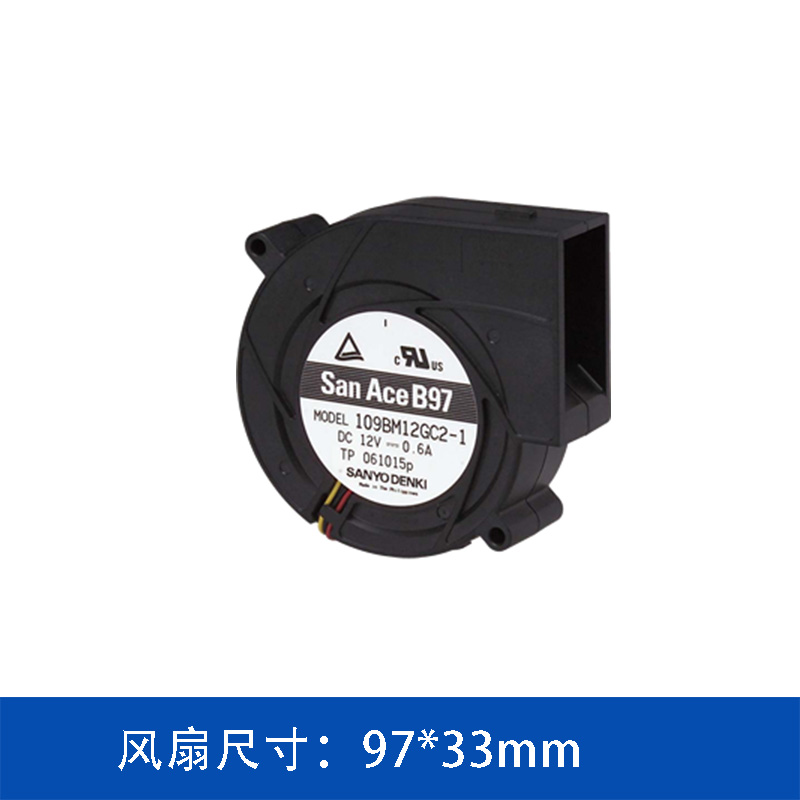
The 109BM12HC2-1 uses a 97×97mm footprint with a 33mm thickness.
Compared with conventional axial fans, a blower changes the direction of airflow through its internal impeller and housing structure. This makes the airflow path easier to integrate into equipment where the intake and exhaust directions cannot be arranged along the same axis.
For compact equipment designers, this can be useful when:
-
Internal components are densely arranged
-
The available cooling space is limited
-
Airflow needs to be redirected inside the enclosure
-
The cooling path contains ducts or narrow passages
-
The fan cannot be installed directly in front of the heat source
The 33mm-thick structure also provides a balance between installation volume and airflow performance for equipment with limited internal space.
2. 12V DC Operation for Compact Electronic Systems
The 109BM12HC2-1 operates at 12V DC, with a rated current of 0.4 A and rated power consumption of 4.8 W.
This electrical specification makes the model suitable for equipment that already has a 12V auxiliary power rail.
Typical considerations include:
-
Embedded electronic equipment
-
Industrial control systems
-
Communication equipment
-
Power electronics
-
Compact instrumentation
-
Network and control hardware
-
Other 12V-powered cooling systems
Using a DC blower can also simplify integration when the equipment's control board already provides a low-voltage DC power supply.
3. Airflow and Static Pressure Performance
Cooling fan selection should not be based on maximum airflow alone.
The 109BM12HC2-1 provides:
|
Parameter
|
Specification
|
|
Fan type
|
DC Blower
|
|
Size
|
97 × 97 × 33 mm
|
|
Rated voltage
|
12 V DC
|
|
Rated current
|
0.4 A
|
|
Rated power
|
4.8 W
|
|
Rated speed
|
3300 min-1
|
|
Maximum airflow
|
0.71 m³/min
|
|
Maximum airflow
|
25.1 CFM
|
|
Maximum static pressure
|
204 Pa
|
|
Maximum static pressure
|
0.819 inchH₂O
|
|
Noise level
|
48.5 dBA
|
|
Sensor
|
Pulse sensor
|
|
Expected life
|
40,000 h at 60°C / 70,000 h at 40°C
|
The combination of 25.1 CFM maximum airflow and 204 Pa maximum static pressure gives the model useful performance for compact systems where airflow resistance cannot be ignored.
In an actual application, however, the operating airflow will depend on the system impedance. Ducts, filters, heat sinks, protective grilles and narrow air passages can all increase resistance.
Therefore, engineers should evaluate the fan using its P-Q performance curve and the equipment system curve, rather than selecting a model solely from its maximum airflow value.
4. Why a Blower Can Be Useful in Compact Equipment
An axial fan generally pushes air in the same direction as the fan's intake axis. A blower uses a different airflow arrangement, allowing the outlet direction to be changed through the housing.
This is particularly useful when the thermal design requires air to move through a defined internal route.
For example, a compact enclosure may be arranged as:
Air inlet → blower → heat-generating component → heat sink → air outlet
The blower can help direct airflow through the intended cooling path rather than simply moving air inside the enclosure.
This characteristic becomes more valuable when the equipment contains:
-
Heat sinks
-
Narrow ventilation channels
-
Multiple electronic boards
-
Internal partitions
-
High-resistance filters
-
Enclosed power modules
5. 48.5 dBA Noise Level for Equipment Cooling
The rated noise level of the 109BM12HC2-1 is 48.5 dBA.
For equipment installed in offices, laboratories, communication rooms or other relatively noise-sensitive environments, fan noise can become an important part of the overall product design.
Fan noise is affected not only by the fan itself but also by:
-
Rotational speed
-
Airflow velocity
-
Outlet structure
-
Duct geometry
-
Grille design
-
Equipment resonance
-
Installation position
Consequently, reducing system resistance can sometimes help lower the required fan operating speed and improve the overall acoustic performance of the equipment.
6. Pulse Sensor for Fan Status Monitoring
The 109BM12HC2-1 incorporates a pulse sensor.
For equipment requiring continuous operation, fan monitoring can provide an additional layer of system protection.
The pulse signal can be used by the host controller to monitor fan rotation and identify abnormal operating conditions.
For example, the equipment controller can monitor the fan signal and respond to conditions such as:
-
Fan rotation failure
-
Abnormally low rotational speed
-
Fan disconnection
-
Cooling system malfunction
This is especially relevant for equipment where a fan failure could cause the internal temperature to rise beyond the allowable operating range.
7. Expected Service Life for Long-Term Equipment Operation
The specified expected life of the 109BM12HC2-1 is:
40,000 hours at 60°C / 70,000 hours at 40°C.
This specification should be understood together with the actual operating environment.
Fan service life can be affected by:
-
Ambient temperature
-
Internal equipment temperature
-
Dust accumulation
-
Operating voltage
-
Fan speed
-
Installation orientation
-
Operating duty cycle
For this reason, the expected life value should not be interpreted as a guaranteed operating period under every application condition. During equipment development, thermal conditions and actual operating points should be evaluated together.
8. Where Can the 109BM12HC2-1 Be Used?
With its compact 97×97×33mm size, 12V DC input, moderate airflow and static-pressure capability, the 109BM12HC2-1 can be considered for a range of compact electronic cooling applications.
Potential applications include:
Industrial Control Equipment
Control cabinets and compact automation equipment often contain multiple heat-generating electronic components in a relatively restricted space. A blower can help establish a defined internal airflow route.
Communication and Network Equipment
Communication hardware may require continuous cooling while maintaining reasonable equipment dimensions. The compact blower format can be useful where the airflow direction needs to be controlled.
Power Electronics
Power supplies, converters and control modules can generate localized heat. Directing airflow toward a heat sink or specific thermal zone can improve the effectiveness of forced-air cooling.
Instrumentation
Laboratory and industrial instruments may have limited internal space and specific acoustic requirements. A compact DC blower provides another option for thermal management.
Embedded Systems
For enclosed electronic systems, a blower can be integrated into the equipment's internal air path without requiring the same installation arrangement as a conventional axial fan.
9. 109BM12HC2-1 at a Glance
The key specifications of the SANYO DENKI San Ace 109BM12HC2-1 can be summarized as follows:
-
Model: 109BM12HC2-1
-
Product type: DC Blower
-
Brand: SANYO DENKI / San Ace
-
Dimensions: 97 × 97 × 33 mm
-
Rated voltage: 12 V DC
-
Rated current: 0.4 A
-
Rated power: 4.8 W
-
Rated speed: 3300 min-1
-
Maximum airflow: 0.71 m³/min / 25.1 CFM
-
Maximum static pressure: 204 Pa / 0.819 inchH₂O
-
Noise: 48.5 dBA
-
Sensor: Pulse sensor
-
Expected life: 40,000 h at 60°C / 70,000 h at 40°C
These specifications make the 109BM12HC2-1 a suitable candidate when a compact 12V DC blower with controlled airflow direction is required.
10. Selecting the Right 9733 Blower for Your Equipment
The 109BM12HC2-1 is one option within the 97×97×33mm blower family. Different models in the same size class can provide substantially different airflow, static pressure, rotational speed, power consumption and noise characteristics.
For this reason, the correct model should be selected according to the complete thermal system rather than the fan dimensions alone.
A practical selection process should consider:
1. Available installation space
Confirm the 97×97×33mm mounting envelope.
2. Power supply
Confirm that the equipment can provide a suitable 12V DC supply.
3. Required airflow
Determine the actual airflow required by the heat-generating components.
4. System resistance
Consider heat sinks, filters, ducts, grilles and other airflow restrictions.
5. Operating noise
Evaluate whether the equipment has acoustic limitations.
6. Fan monitoring
Determine whether the pulse sensor should be connected to the equipment controller.
7. Operating temperature and service life
Compare the expected fan operating temperature with the required equipment lifetime.
Conclusion
The SANYO DENKI San Ace 109BM12HC2-1 is a 97×97×33mm, 12V DC blower designed for compact equipment where airflow direction, system resistance, power consumption and installation space all need to be considered.
With a rated power of 4.8 W, maximum airflow of 25.1 CFM, maximum static pressure of 204 Pa, noise level of 48.5 dBA, and a built-in pulse sensor, the model provides a balanced solution for a variety of compact electronic cooling applications.
For equipment designers, the most important point is not simply to compare the maximum airflow of different fans. The actual operating point should be evaluated against the equipment's airflow resistance, thermal load and installation structure. This approach helps determine whether the 109BM12HC2-1 is the appropriate blower for the specific cooling system.
 ∷
∷




 Click to inquire